
One call to the wrong number. One contact who revoked consent three weeks ago but whose opt-out never made it into your list. That’s all it takes. Under the Telephone Consumer Protection Act (TCPA), DNC scrubber and TCPA compliance failures aren’t just embarrassing — they’re existential. Fines run from $500 to $1,500 per call, and class action lawsuits in this space routinely settle in the millions.
In 2026, the regulatory environment has grown teeth it didn’t have five years ago. New FCC rules have expanded consumer opt-out rights, tightened consent requirements, and made it significantly harder for call centers to claim ignorance as a defense. If your DNC scrubbing process is anything less than automated, real-time, and rigorously documented, your outbound operation is running on borrowed time.
This guide explains exactly what DNC scrubbing is, what TCPA compliance requires in 2026, and what a modern call center needs to do to stay protected.
What Is a DNC Scrubber?
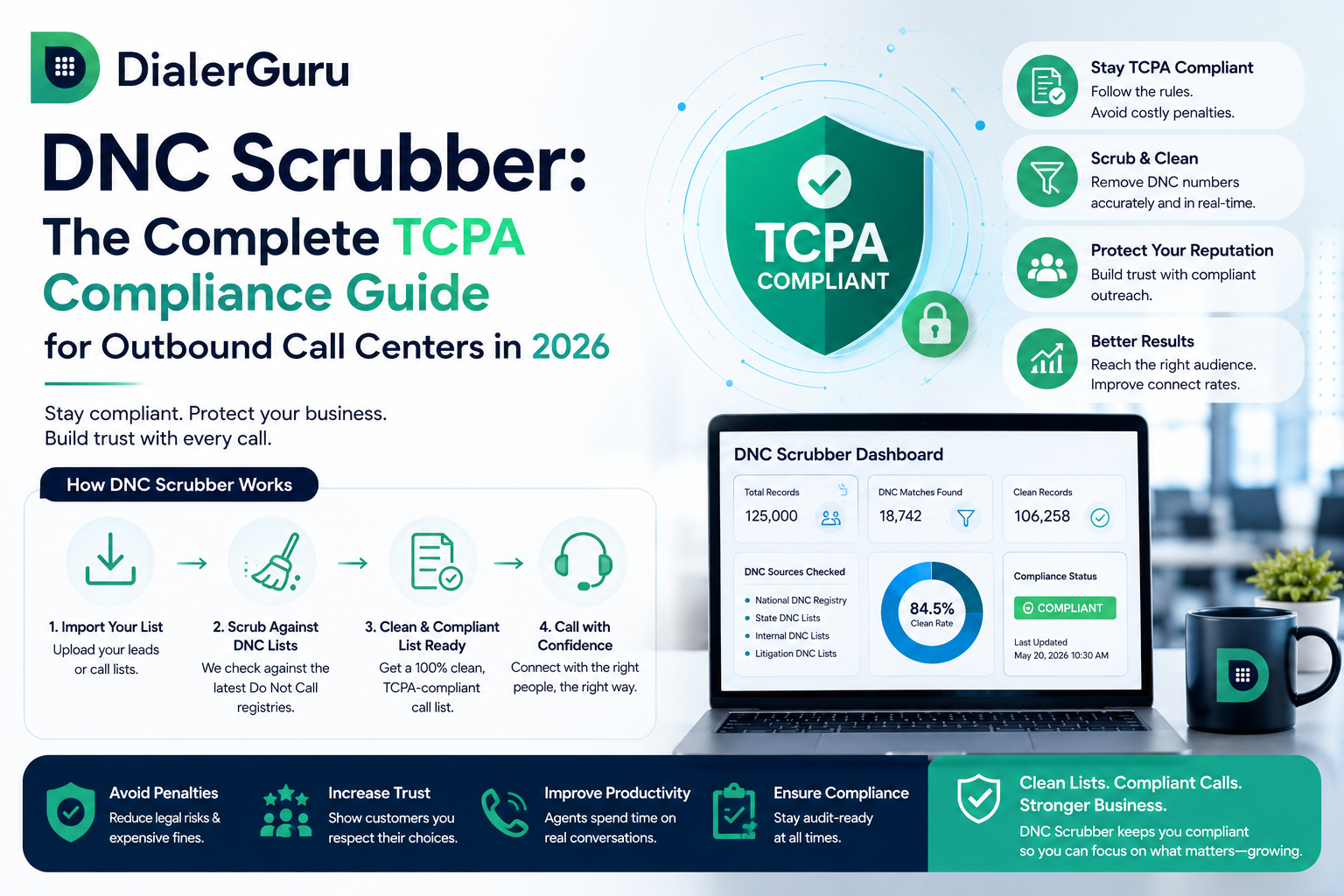
A DNC scrubber is software that cross-references your outbound call list against one or more Do Not Call registries — including the federal National DNC Registry, state-level DNC lists, and your own internal opt-out records — and automatically removes any numbers that match.
Before a single outbound call is placed, the scrubber has already cleaned the list. Numbers associated with consumers who have opted out, registered on the DNC list, or otherwise withdrawn consent are suppressed. Your agents never see them. Your dialer never dials them.
That’s the promise. In practice, the quality and frequency of your scrubbing process determines whether that promise holds up under legal scrutiny.
TCPA Compliance in 2026: What’s Changed and What Still Applies
The TCPA has been federal law since 1991, but its enforcement has intensified dramatically over the past decade — and 2025 brought several significant rule changes that every outbound call center needs to understand.
The April 2025 FCC Consent Revocation Rule
This is the biggest change in recent memory. As of April 2025, consumers can revoke their consent to receive calls or texts by any reasonable means — a reply text, a voicemail, an email, or simply telling a live agent “stop calling me.” Prior to this rule, consent revocation was more narrowly defined and easier for businesses to dispute.
Now, businesses have 10 business days to honor opt-outs after receiving them through any channel. If your internal DNC process involves manual list updates or relies on agents to log opt-out requests into your CRM, you have a compliance gap. An automated DNC scrubber that syncs opt-outs in real time is no longer a luxury — it’s required infrastructure.
The 3% Abandoned Call Rate Rule
For call centers running predictive dialers, the FCC’s 3% maximum abandoned call rate remains in effect — applied per campaign over a 30-day measurement period. An abandoned call is any call where a live person answers and no agent is available to take it.
DNC scrubbing intersects with this rule directly: cleaner lists produce better connect rates, which allows your predictive dialer algorithm to make more accurate predictions, which reduces abandoned calls. List hygiene and compliance are inseparable.
TCPA Class Action Exposure
Unlike many compliance frameworks, TCPA violations are privately actionable. Any consumer who receives an improperly placed call can sue — and TCPA class actions have become a significant legal industry in themselves. In 2025, TCPA-related settlements totaled hundreds of millions of dollars across all industries. Call centers are a primary target because the volume of potential violations is high and easily documented.
What Your DNC Scrubbing Process Must Cover
A compliant DNC scrubbing process in 2026 needs to address five distinct list categories:
1. The Federal National DNC Registry
The FTC maintains the National Do Not Call Registry, which contains over 240 million registered phone numbers. Call centers are legally required to access and scrub against this registry. Access requires a paid subscription for commercial operations.
Key rule: You must scrub your list against the federal registry no more than 31 days before any call campaign begins. Lists older than 31 days are non-compliant.
2. State DNC Lists
Several states — including Florida, Indiana, and others — maintain their own DNC registries that operate independently of the federal list. Some states have stricter requirements than federal law. If you’re running national campaigns, your scrubbing process must include all applicable state lists.
3. Your Internal Opt-Out List
Every consumer who tells you to stop calling — through any channel, thanks to the April 2025 rule — must be immediately added to your internal suppression list and honored within 10 business days. This list must be maintained indefinitely and checked on every campaign.
4. Litigator Lists
Sophisticated call centers also scrub against published litigator databases — lists of known serial TCPA plaintiffs who register numbers specifically to generate lawsuit opportunities. While not legally mandated, filtering these numbers dramatically reduces your litigation exposure.
5. Wireless and VOIP Numbers
The rules for calling wireless numbers differ from landlines in certain respects, particularly around consent requirements for automated dialing. Your scrubbing process should flag wireless numbers so your compliance team can verify appropriate consent before campaigns targeting those numbers launch.
Real-Time vs. Batch DNC Scrubbing: Why It Matters
Most legacy DNC scrubbing workflows are batch-based: you upload your list, run it through the scrubber, download the cleaned list, and use it for your campaign. This works — until the 72 hours between your scrub and your campaign launch, during which consumers may have registered on the DNC list or submitted new opt-outs.
Real-time DNC scrubbing checks numbers against all applicable lists at the moment of dial — not at campaign setup. If a consumer registered on the DNC list last Tuesday and your campaign launched last Wednesday, real-time scrubbing catches it. Batch scrubbing doesn’t.
For high-volume outbound operations, real-time scrubbing is the only defensible approach. The marginal cost of the technology is trivial compared to the cost of a single TCPA class action.
→ Dialer Guru’s DNC Scrubber operates in real time, scrubbing against federal, state, and internal lists before every dial — fully integrated with our hosted auto dialer.
Documentation: Your Second Line of Defense
Even a flawless DNC scrubbing process doesn’t protect you if you can’t prove it. TCPA compliance requires documentation:
- Consent records: When and how each consumer gave consent to receive calls
- Opt-out records: When and through what channel each opt-out was received, and when it was honored
- Scrub logs: Timestamped records showing which lists were scrubbed, when, and how many numbers were suppressed
- Campaign records: Which numbers were called, when, by which agent, and the outcome
If you receive a regulatory inquiry or a lawsuit, these records are your defense. Gaps in documentation are treated the same as gaps in compliance.
Modern DNC scrubber platforms maintain these logs automatically. If you’re doing this manually in a spreadsheet, the question isn’t whether you’ll have a documentation problem — it’s when.
STIR/SHAKEN and Caller ID Reputation: The Compliance Stack
DNC scrubbing is one pillar of outbound compliance. Two others are increasingly non-negotiable in 2026:
STIR/SHAKEN is a call authentication framework that verifies your caller ID hasn’t been spoofed. Without it, carriers flag your outbound calls as unverified — which damages answer rates and, in some states, can create additional legal exposure.
Caller ID Reputation Management monitors whether your outbound numbers are being flagged as “Scam Likely” or “Spam” by carriers and third-party databases. A number that’s been flagged can destroy an entire campaign’s effectiveness regardless of how good your dialer is.
Running all three — DNC scrubbing, STIR/SHAKEN authentication, and caller ID monitoring — is the baseline compliance stack for any serious outbound operation in 2026.
→ Dialer Guru’s STIR/SHAKEN Compliance tools and Caller ID Reputation monitoring work alongside our DNC Scrubber to give your call center a fully protected outbound stack.
What Happens If You Get It Wrong
Let’s be concrete. Here’s what a TCPA compliance failure actually costs:
- Statutory damages: $500 per violation for negligent violations; $1,500 per violation for willful violations
- No cap: There is no per-campaign or per-year cap. A campaign that places 10,000 non-compliant calls faces up to $15 million in statutory damages
- Class actions: TCPA class actions are filed regularly. Settlement amounts in the $1M–$50M range are common
- Regulatory action: The FCC can issue its own fines on top of private litigation
- Reputation damage: Regulatory actions against call centers are public record
The businesses that get hit hardest are usually not the ones that had zero compliance measures — they’re the ones that had incomplete compliance measures and assumed that was good enough.
Building a Bulletproof DNC Compliance Process
Here’s a practical framework for outbound call centers at any scale:
Step 1 — Scrub before every campaign. No exceptions. Even if you scrubbed the list last week.
Step 2 — Automate your internal opt-out capture. Every channel where a consumer can express opt-out (phone, email, text, web form) should feed directly into your DNC suppression list without any manual steps.
Step 3 — Set your 10-day clock. When an opt-out comes in through any channel, start the clock. 10 business days is the legal deadline for honoring it. Automate this with your CRM.
Step 4 — Document everything. Scrub logs, consent records, opt-out records. Store them for at least 5 years.
Step 5 — Monitor your caller ID reputation. Even a clean list won’t help if your numbers are flagged as spam. Run regular reputation checks.
Step 6 — Train your agents. Agents should understand what TCPA is, what a verbal opt-out means, and how to log it immediately. This is your human last line of defense.
Final Word
TCPA compliance isn’t a competitive differentiator — it’s table stakes. The call centers that fail in 2026 aren’t usually the ones building the best sales scripts or running the best dialers. They’re the ones that underestimated compliance until the settlement demand arrived.
A reliable DNC scrubber, combined with real-time opt-out automation, proper documentation, and a compliant dialer platform, is the infrastructure that lets your outbound operation scale without catastrophic risk.
Build that infrastructure before you need to explain to a class action attorney why you didn’t.
Dialer Guru’s DNC Scrubber is built for real-time compliance at scale — fully integrated with our Hosted Auto Dialer, STIR/SHAKEN tools, and Caller ID Reputation monitoring. Get in touch with our team to see how we protect your outbound campaigns.