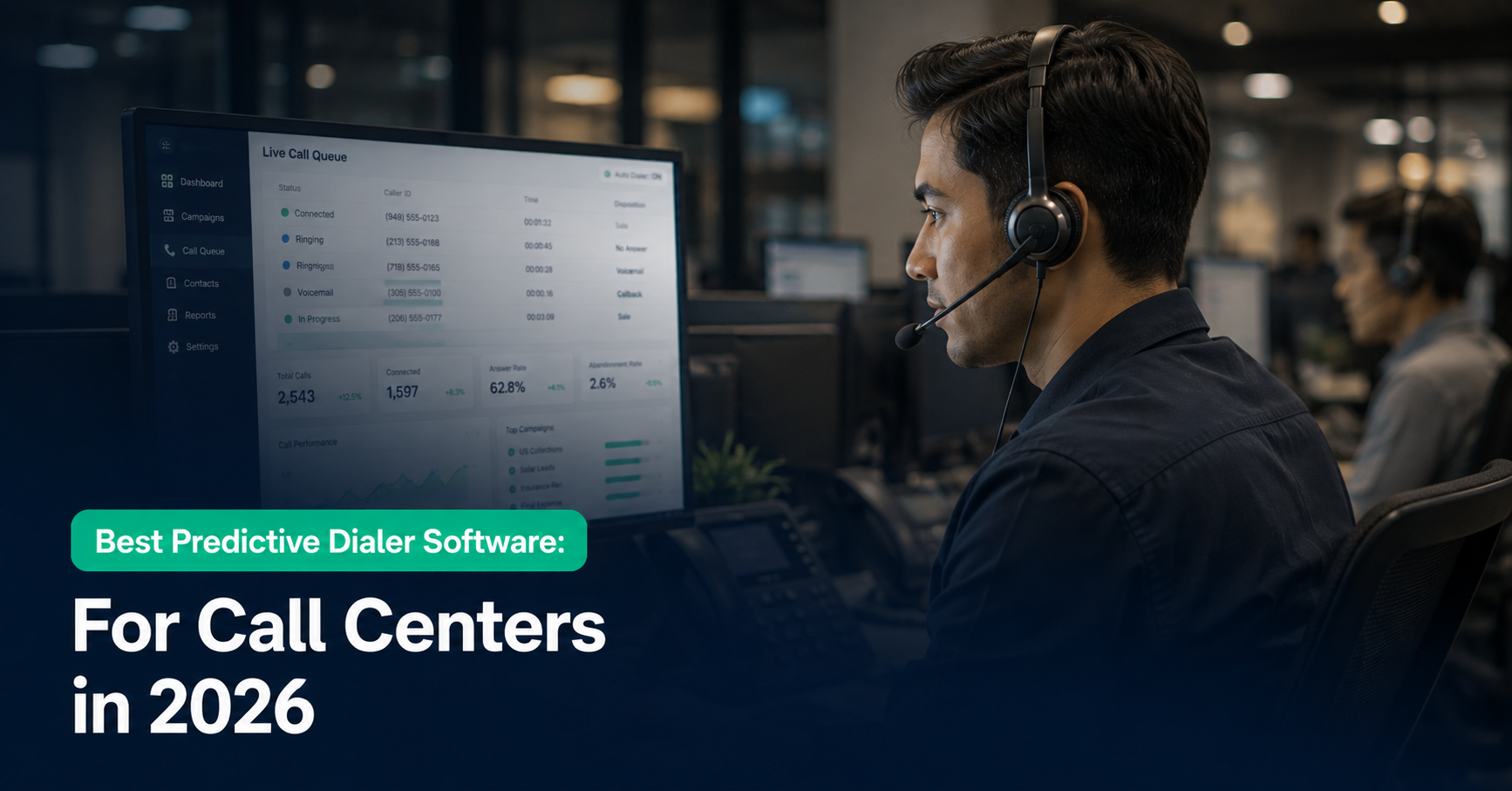
Best Predictive Dialer Software for Call Centers in 2026

Choosing predictive dialer software comes down to three things that most buyer’s guides gloss over: how accurately the pacing algorithm predicts agent availability, how well the platform manages abandonment rates and caller ID reputation, and whether the pricing model matches your actual call volume. Get any of those wrong and the “productivity boost” a predictive dialer promises turns into dropped calls, compliance exposure, or a bill that doesn’t match what you were quoted.

This guide breaks down what predictive dialer software actually does, what to evaluate before buying, and how five leading platforms — Dialer Guru, Five9, Convoso, ReadyMode, and DialedIn by ChaseData — compare on dialing modes, compliance tooling, and pricing.

Key Takeaways

  • A predictive dialer uses a pacing algorithm to place multiple calls per agent based on statistical models of pickup rates and average handle time, maximizing talk time but requiring active abandonment-rate management.
  • The best predictive dialer for your team depends on call volume and compliance posture, not just feature count — a 10-agent lead-gen team and a 200-agent BPO floor need different things.
  • Answering machine detection (AMD) accuracy and caller ID reputation management directly affect whether predictive dialing’s efficiency gains actually reach your agents as live conversations.
  • Most predictive dialer vendors, including several compared here, use custom quote-based pricing — confirm current numbers directly before budgeting.

What Is Predictive Dialer Software?

Predictive dialer software automatically places outbound calls to multiple numbers per agent simultaneously, using an algorithm that predicts when an agent will next be free based on current call durations, historical answer rates, and the number of agents logged into a campaign. When a call is answered by a live person, it’s routed to the next available agent; unanswered calls, busy signals, and voicemails are filtered out before ever reaching an agent’s line. This is what separates a predictive dialer from a power dialer (one call per agent, agent-triggered) or a preview dialer (agent reviews the record before the call is placed).

How Predictive Dialing Works

The pacing algorithm continuously recalculates a “dial ratio” — how many calls to place per available agent — based on real-time answer rates and average talk time. Set the ratio too aggressively and more calls get answered than there are agents free to take them, causing abandoned calls (a compliance and customer-experience problem). Set it too conservatively and agents sit idle between calls, erasing the productivity gain. Modern platforms adjust this ratio dynamically throughout a campaign rather than using a fixed setting, which is one of the biggest differentiators between dialer vendors even though it rarely shows up as a headline feature.

What to Look For in Predictive Dialer Software

  • Dynamic pacing with abandonment-rate controls. Look for a platform that lets supervisors set and monitor abandonment thresholds in real time, not just at campaign setup.
  • Accurate answering machine detection (AMD). AMD that misclassifies live answers as voicemail wastes contacts; AMD that misses actual voicemails wastes agent time. Ask vendors for their AMD accuracy methodology, not just a percentage claim.
  • Built-in DNC scrubbing and consent tracking, ideally refreshed against current suppression lists automatically rather than manually.
  • Caller ID reputation monitoring. A dialer can pace calls perfectly and still fail if the outbound numbers are being flagged “Spam Likely” by carriers — number reputation management should be part of the platform, not a separate purchase.
  • Multiple dialing modes in one platform (predictive, progressive, preview, manual) so supervisors can dial down aggressiveness for high-risk campaigns without switching software.
  • Transparent pricing that scales predictably with seats and call volume.
  • CRM and lead-source integrations to avoid manual list management.

Comparing the Best Predictive Dialer Software

Provider Best For Dialing Modes AMD Compliance Tooling Reported Starting Price*
Dialer Guru Outbound-first teams (sales, collections, lead gen, solar/insurance, BPO) wanting compliance built in Predictive, progressive, preview, manual AI-based AMD DNC scrubber, STIR/SHAKEN support, caller ID reputation management Custom quote
Five9 Enterprise omnichannel contact centers Predictive, power, preview AMD included Compliance and WFM tools at higher tiers ~$119/seat/month (reported)
Convoso High-volume outbound sales and collections Predictive, power, preview, progressive “Best-in-class” voicemail detection (vendor claim) DNC integration, TCPA tooling, caller ID reputation add-ons ~$90/seat/month (reported), quote-based
ReadyMode All-in-one dialer + CRM for outbound teams Predictive, power, progressive, preview (multiline) AMD included Built-in compliance tools ~$199–$249/user/month (reported)
DialedIn (ChaseData) Small-to-mid size teams wanting tiered, published pricing Auto, predictive, preview, progressive AMD included Compliance tools vary by tier ~$49–$169/agent/month across tiers (reported)

*Pricing figures are publicly reported by third-party review sites as of this writing, not official vendor quotes, and predictive dialer pricing typically varies by seat count, call volume, and contract length. Confirm current numbers directly with each vendor.

Where Each Platform Is Actually Stronger

Five9 is stronger for large, blended contact centers that need deep omnichannel routing (voice, chat, email) and enterprise workforce management alongside outbound dialing.

Convoso is stronger for high-volume sales and collections operations that want an AI-driven virtual agent layer and don’t mind a quote-only sales process.

ReadyMode is stronger if you want dialer and CRM bundled into a single subscription and are comfortable with a higher per-seat price for that convenience.

DialedIn by ChaseData is stronger for smaller teams that want published, tiered pricing they can evaluate without a sales call.

Dialer Guru is stronger for outbound-focused operations — telemarketing, lead generation, collections, solar, insurance, real estate, BPO — where compliance and caller ID deliverability need to be core to the platform rather than assembled from multiple vendors. Because DNC scrubbing, STIR/SHAKEN alignment, AI-based AMD, and caller ID reputation monitoring are part of the base platform, supervisors get a full compliance and deliverability stack without stitching together separate tools, and can shift between predictive, progressive, preview, and manual dialing per campaign based on regulatory risk.

Who should look elsewhere: teams that need heavy omnichannel (chat, email, social) alongside outbound calling are usually better served by a full CCaaS suite like Five9 rather than an outbound-specialist platform.

Predictive Dialer Compliance: What to Know Before You Buy

Predictive dialing carries specific regulatory considerations under the Telephone Consumer Protection Act (TCPA), which governs autodialed and prerecorded calls to consumers in the U.S., along with FCC rules on call authentication (STIR/SHAKEN) aimed at reducing illegal robocalls and caller ID spoofing. No dialer software is “compliant” by itself — compliance depends on how a business configures consent tracking, DNC scrubbing, and abandonment-rate thresholds on whatever platform it uses. Requirements can change, so verify current obligations with the FCC or legal counsel rather than relying solely on a vendor’s marketing claims. For a deeper walkthrough of DNC list management specifically, see our DNC scrubber and TCPA compliance guide.

Predictive Dialer vs. Power Dialer: Which Do You Actually Need?

Not every outbound team needs a predictive dialer. Predictive dialing maximizes talk time by placing multiple calls per agent but requires active abandonment-rate management; power dialing places one call at a time, agent-triggered, trading dial speed for a simpler compliance profile. Larger outbound teams with dedicated compliance processes typically benefit most from predictive dialing’s efficiency; smaller teams sometimes prefer a power dialer’s lower regulatory exposure even at reduced volume. We cover this tradeoff in more detail in predictive dialer vs. power dialer vs. auto dialer, and if you’re currently on a platform like Convoso and evaluating a switch, see our breakdown of Convoso alternatives.

FAQ

What is predictive dialer software?

Predictive dialer software automatically places multiple outbound calls per agent using an algorithm that predicts agent availability from real-time answer rates and call durations, connecting agents only to live conversations.

How does predictive dialing work?

The system calculates a dial ratio — how many calls to place per available agent — based on historical and real-time answer data, then adjusts that ratio continuously throughout the campaign to balance agent utilization against abandoned-call risk.

Is predictive dialing legal?

Predictive dialing is legal in the U.S. but is regulated under the TCPA, which imposes consent and abandonment-rate requirements, particularly for calls to wireless numbers. Compliance depends on how the campaign is configured, not the software alone — verify current rules with the FCC or legal counsel.

What is a good call abandonment rate?

Under FCC TCPA rules, outbound telemarketing campaigns using predictive dialers are generally required to keep abandonment rates at or below 3% per campaign, measured over a 30-day period — confirm current thresholds directly with the FCC or counsel, since rules can be updated.

What’s the best predictive dialer for a small team?

Smaller teams often do better starting with a power or preview dialer, or a predictive dialer platform with published, lower-tier pricing such as DialedIn by ChaseData, rather than committing to a high-volume enterprise platform.

What’s the best dialer for a BPO?

BPOs generally need a platform that supports high concurrent agent counts, multiple simultaneous campaigns, built-in compliance tooling across regions, and caller ID reputation management at scale — criteria that hosted predictive dialer platforms like Dialer Guru and ReadyMode are built around.

How much does predictive dialer software cost?

Pricing varies widely by vendor and is often quote-based rather than published, typically ranging from roughly $50 to $250+ per agent per month depending on features, call volume, and contract length. Always confirm current pricing directly with the vendor.

Do I need answering machine detection (AMD)?

If your campaigns involve high call volumes, AMD is close to essential — it prevents agents from wasting time on voicemails and unanswered lines, though AMD accuracy varies by vendor and should be evaluated during a trial or demo, not assumed from a spec sheet.

See how Dialer Guru’s hosted predictive dialer combines dynamic pacing, AI-based answering machine detection, and built-in TCPA compliance tools — explore Dialer Guru’s predictive dialing solutions or talk to the team about your call center’s specific volume and compliance needs.
5 Best Convoso Alternatives for Outbound Call Centers in 2026

If you’re reading this, you’re probably already running campaigns on Convoso and hitting a wall — pricing that climbs every time you add a seat or feature, occasional dropped calls during peak hours, or a quote-only sales process that makes it hard to budget. You’re not alone. It’s one of the most common reasons outbound teams start evaluating a replacement.

This guide compares five real Convoso alternatives — Five9, Talkdesk, ReadyMode, PhoneBurner, and Dialer Guru — on the things that actually matter when you’re running an outbound campaign: dialing modes, compliance tooling, pricing structure, and who each one is actually built for.

Key Takeaways

  • Convoso is a solid multimode predictive/power dialer, but its quote-only, seat-tied pricing and reported call-reliability complaints are the top reasons teams look elsewhere.
  • Not every alternative is built for the same job. Enterprise CCaaS platforms (Five9, Talkdesk) suit omnichannel support orgs; hosted predictive dialers (ReadyMode, Dialer Guru) suit outbound-only sales, collections, and lead-gen teams; power dialers (PhoneBurner) suit smaller teams that want to stay clearly on the TCPA-safe side of automated dialing.
  • Compliance tooling — DNC scrubbing, STIR/SHAKEN, caller ID reputation — should be a baseline requirement, not an upsell, if your team makes high call volumes.
  • Always confirm current pricing directly with each vendor; most predictive dialer providers, Convoso included, don’t publish full pricing and quote based on seats, usage, and features.

What Is Convoso, Briefly

Convoso is a cloud-based outbound contact center platform built around a multimode dialer (predictive, power, preview, progressive) with dynamic scripting, an AI-driven “Intelligent Virtual Agent,” and workflow automation aimed at high-volume sales, lead generation, and collections teams. Pricing is not published; third-party sources report per-seat costs in roughly the $90+/month range on annual contracts, with carrier/telecom usage billed separately.

Why Outbound Teams Look for a Convoso Alternative

A few reasons come up repeatedly across user reviews and competitor research:

  • Pricing that scales unpredictably. Costs are tied to seat count and the specific features/integrations bundled in, so a growing team can see its bill jump in ways that are hard to forecast without a sales call.
  • Reported reliability issues. Some users describe dropped or delayed connections and system slowdowns during high-traffic periods — a real problem when agent time is the most expensive resource in an outbound campaign.
  • Caller ID and deliverability pressure. Like every high-volume outbound platform, Convoso campaigns can run into “Spam Likely” or “Scam Likely” labeling from carriers if number reputation isn’t actively managed — this is an industry-wide challenge, not unique to Convoso, but it’s a common trigger for re-evaluating your whole stack, including caller ID reputation tooling.
  • Opaque, quote-only pricing. No public pricing page makes it harder to compare options quickly before committing time to a sales cycle.

What to Look For in a Convoso Replacement

Before comparing vendors, it helps to define what actually matters for your campaigns:

  • Dialing modes that match your compliance posture. Predictive dialing maximizes agent talk time but carries more regulatory exposure under the TCPA if numbers include wireless lines without proper consent; power and preview modes trade some efficiency for a clearer compliance story.
  • Built-in DNC scrubbing and consent tracking, not a bolt-on.
  • STIR/SHAKEN-aligned caller ID practices and active number reputation monitoring, since carrier spam-labeling can silently tank contact rates regardless of which dialer you use.
  • Transparent, predictable pricing you can model against your seat count and call volume.
  • CRM and lead-source integrations so agents aren’t toggling between systems.
  • Support responsiveness — outbound campaigns lose money every minute a dialer is down.

Comparing the Best Convoso Alternatives

Provider Best For Dialing Modes Compliance Tooling Reported Starting Price*
Dialer Guru Outbound-only teams (sales, collections, lead gen, solar/insurance) wanting compliance-first hosted dialing Predictive, progressive, preview, manual, click-to-call DNC scrubber, STIR/SHAKEN support, AI answering machine detection, caller ID reputation management Custom quote (not publicly listed)
Five9 Enterprise omnichannel contact centers (voice + chat + email) Predictive, power, preview Compliance and WFM tools bundled at higher tiers ~$119/seat/month (reported)
Talkdesk Mid-market to enterprise teams wanting deep CRM/AI integration Predictive, power, preview Built-in compliance and QA suite ~$85/user/month (reported)
ReadyMode High-volume outbound sales and collections teams wanting an all-in-one dialer + CRM Predictive, power, progressive, preview (multiline, 12–28 lines/agent) Built-in compliance tools ~$199–$249/user/month (reported)
PhoneBurner Smaller sales teams wanting a manual-trigger power dialer to stay clearly TCPA-safe Power (single-line, agent-triggered) Relies on manual dialing to avoid autodialer classification risk ~$165–$215/user/month (reported)

*Pricing figures are publicly reported by third-party review sites as of this writing and are not official vendor quotes. Predictive dialer pricing typically varies by seat count, call volume, and contract length — confirm current numbers directly with each vendor before budgeting.

Where Each Alternative Is Actually Stronger

Comparison content isn’t useful if it just pushes one option, so here’s an honest breakdown.

Five9 and Talkdesk are stronger if you run a blended contact center that needs deep omnichannel support (voice, chat, email, social) alongside outbound dialing, or if you need enterprise-grade workforce management and a large third-party integration marketplace. They’re built for organizations where outbound is one function among several, not the entire operation.

ReadyMode is stronger if you want an all-in-one dialer-plus-CRM in a single subscription and don’t mind a higher per-seat price for that bundling.

PhoneBurner is stronger for smaller teams — think a 5–15 person sales floor — that want the simplicity and lower compliance risk of agent-triggered power dialing over predictive dialing, and don’t need enterprise-scale campaign management.

Dialer Guru is stronger if your operation is outbound-first — telemarketing, lead generation, collections, solar, insurance, real estate, or BPO — and compliance and number deliverability are core to how you run campaigns rather than an afterthought. Because DNC scrubbing, STIR/SHAKEN alignment, and caller ID reputation monitoring are built into the platform rather than sold as premium add-ons, teams get a compliance foundation without assembling it from separate tools. The predictive, progressive, preview, and manual dialing modes let a supervisor match dialing aggressiveness to the campaign’s regulatory risk profile rather than being locked into one approach.

Who should stick with Convoso or a large CCaaS suite: if you already have a mature, blended inbound/outbound operation with heavy CRM customization built around Convoso or a platform like Five9, migrating has real switching costs — evaluate carefully before moving for pricing reasons alone.

Who should consider Dialer Guru: outbound-focused teams that want predictable communication with a live support team, compliance tooling built in rather than bolted on, and dialing-mode flexibility without paying for omnichannel features they won’t use.

Predictive Dialer vs. Power Dialer: A Quick Compliance Note

One theme that comes up in almost every Convoso-alternative search: whether to stay on a predictive dialer or move to a power/preview dialer for TCPA safety. Predictive dialing places multiple calls per agent based on statistical models of pickup rates, which maximizes talk time but requires stricter consent and abandonment-rate compliance. Power and preview dialing place calls one at a time, agent-triggered, which is generally viewed as lower regulatory risk but also lowers dial volume per agent. Neither mode is inherently “compliant” or “non-compliant” — compliance comes from how consent, DNC scrubbing, and abandonment thresholds are managed regardless of mode. For a deeper breakdown, see our guide on predictive dialer vs. power dialer vs. auto dialer.

Migration Considerations

Switching platforms mid-campaign has real costs, so plan for:

  • Number porting and caller ID reputation transfer. Moving DIDs to a new platform can temporarily affect answer rates — a caller ID reputation management process should be part of the migration plan, not an afterthought.
  • DNC and consent data migration. Your suppression lists need to move cleanly; see our DNC scrubber and TCPA compliance guide for what a complete list needs to include.
  • Agent retraining on new scripting and disposition workflows.
  • Parallel running a small pilot campaign before fully cutting over.

FAQ

What is the closest alternative to Convoso for outbound sales teams?
Among hosted predictive dialers built specifically for outbound campaigns, ReadyMode and Dialer Guru are the closest functional matches to Convoso, since both bundle predictive/power/preview dialing with compliance tooling in a single platform rather than requiring a full CCaaS suite.

Why do people switch away from Convoso?
The most commonly cited reasons are unpredictable seat-based pricing, quote-only pricing that complicates budgeting, and reported call reliability issues during peak usage — not a lack of dialing features.

Is Convoso TCPA compliant?
Convoso provides TCPA-oriented compliance tools such as DNC integration and calling-hour restrictions, but no dialer platform is “TCPA compliant” on its own — compliance depends on how a business configures consent tracking, DNC scrubbing, and abandonment rates on any platform it uses. Requirements can change, so verify current obligations with the FCC or legal counsel.

What’s the difference between a predictive dialer and a power dialer?
A predictive dialer places multiple calls per agent based on a statistical model of expected pickups, maximizing talk time but carrying more dropped-call and abandonment-rate risk. A power dialer places one call at a time, triggered by the agent, trading some dial speed for a simpler compliance profile. See our full comparison of predictive, power, and auto dialers.

How much does Convoso cost per seat?
Convoso does not publish pricing publicly. Third-party sources report roughly $90+ per seat/month on annual contracts, with telecom/carrier usage billed separately — confirm current pricing directly with Convoso’s sales team.

Is VICIdial free?
VICIdial itself is open-source and free to self-host, but most businesses use a hosted or managed version (like Dialer Guru’s hosted platform) to avoid managing servers, telecom carriers, and compliance configuration in-house.

What causes outbound calls to show as “Scam Likely”?
Carriers assign risk scores to phone numbers based on call volume, complaint reports, and calling patterns. High-volume outbound dialing — regardless of platform — can trigger these labels if number reputation isn’t actively monitored and managed, which is why caller ID reputation tools matter as much as the dialer itself.

Do I need a predictive dialer, or would a power dialer be safer?
It depends on team size and risk tolerance. Larger outbound teams often need predictive dialing’s efficiency and manage compliance through strict consent and abandonment controls; smaller teams sometimes prefer power dialing’s simpler compliance story even at lower dial volume.

Related Reading

Sources

If your team is outbound-first and you’re evaluating a move off Convoso, see how Dialer Guru’s hosted predictive dialer combines compliance tooling, caller ID reputation management, and flexible dialing modes in one platform — then talk to Dialer Guru about a migration plan that fits your campaigns.

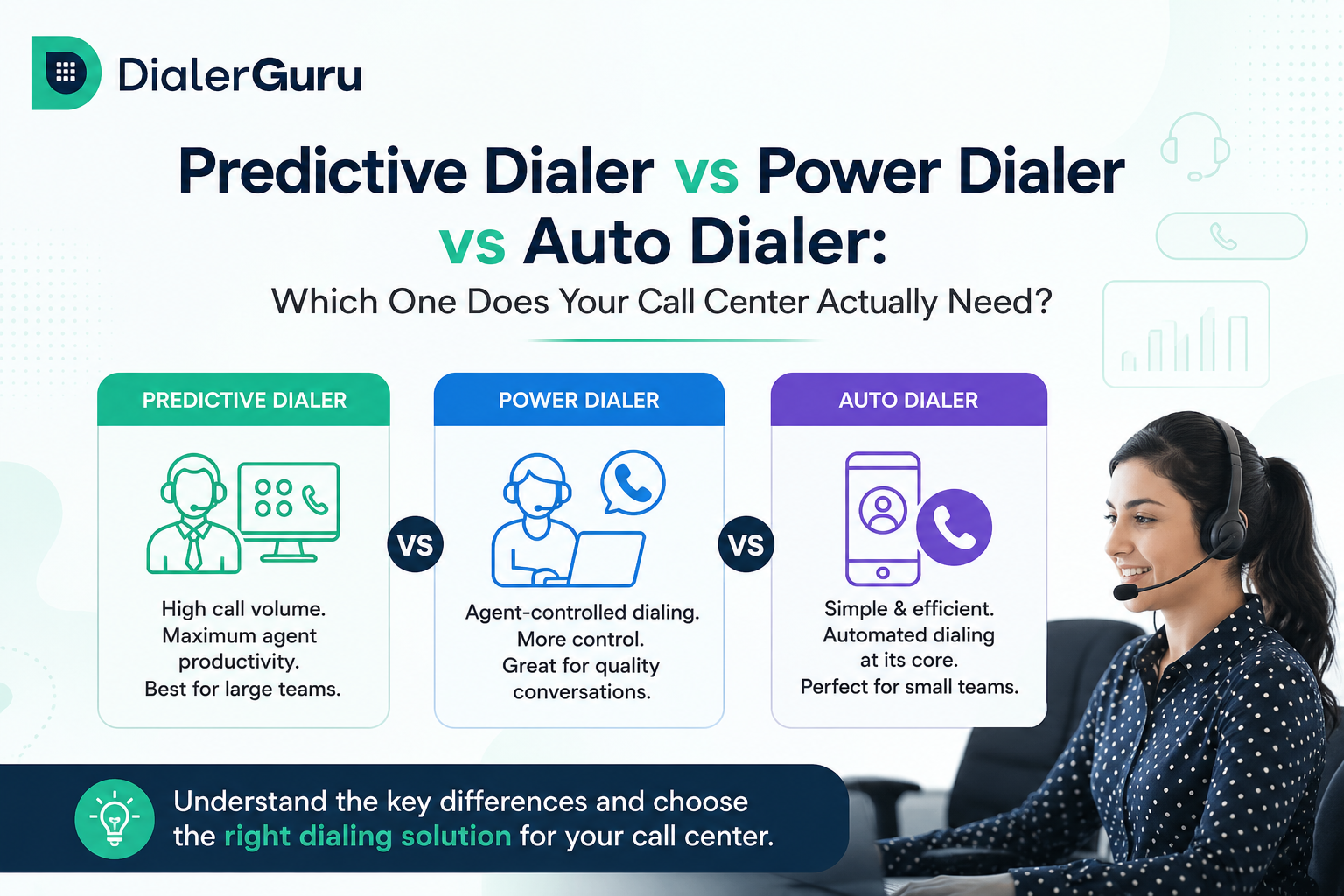
Predictive Dialer vs Power Dialer vs Auto Dialer: Which One Does Your Call Center Actually Need?

Choosing the wrong dialer can quietly kill your call center’s productivity — and in 2026, it can expose you to regulatory fines you never saw coming. If you’ve been researching predictive dialer vs power dialer options and feel overwhelmed by conflicting advice, you’re not alone. Most guides either oversimplify or bury you in technical jargon. This one won’t.

Here’s the truth: “auto dialer” is an umbrella term. What lives beneath it — predictive, power, and progressive dialers — are fundamentally different machines that serve very different operations. Choosing the right one is less about brand preference and more about understanding your team size, your call volume, and how much compliance risk you can realistically manage.

Let’s break it down clearly.

What Is an Auto Dialer, Really?

An auto dialer is any software that automatically dials phone numbers from a list without requiring an agent to punch in each number manually. That’s where the similarity ends. The term “auto dialer” covers at least three distinct dialing modes — and the one you choose will determine your agent productivity, your customer experience, and your legal exposure.

Think of it this way: a pickup truck, an SUV, and a sports car are all “vehicles.” But you wouldn’t take a sports car off-road. Same logic applies here.

Power Dialer: Quality Over Quantity

A power dialer dials one number at a time, per agent. The moment the previous call ends — whether it connected or not — the system automatically places the next call. The agent is live on the line from the first ring, meaning no delayed connection, no awkward silence, and no “telemarketer pause” when the prospect picks up.

How it works:

  • System dials the next contact the instant an agent becomes available
  • Agent sees full CRM data while the phone rings
  • If voicemail answers, the agent drops a pre-recorded message and moves on
  • Zero abandoned calls — every answered call connects to a live person

Best for:

  • B2B sales teams
  • Account-based outreach with high-value prospects
  • Teams of fewer than 8 agents
  • Industries where first impressions are everything (real estate, insurance, healthcare)

Compliance profile: Very low risk. Because every call has a live agent ready before connection, power dialers are TCPA-compliant by design. No abandoned call issues.

The trade-off: Speed. A skilled agent on a power dialer can make 80–120 calls per day — impressive, but lower ceiling than predictive dialers in pure volume terms.

Predictive Dialer: Maximum Volume, Maximum Caution Required

A predictive dialer uses an algorithm to dial multiple numbers simultaneously per agent pool. It predicts using real-time data like average call duration, answer rates, and agent availability when an agent will finish their current call. By the time the next prospect picks up, an agent should theoretically be free.

In a well-tuned operation, this can boost agent talk time by 200–300% compared to manual dialing.

How it works:

  • Algorithm dials 3–5+ numbers per agent simultaneously
  • Answered machine calls are automatically filtered and dropped
  • Live connections are routed to the first available agent
  • Unanswered numbers, busy signals, and disconnected lines are discarded

Best for:

  • Large call centers with 50+ agents
  • High-volume consumer campaigns (telemarketing, debt collection, political outreach)
  • Short-call-duration campaigns like surveys or reminders
  • Situations where raw contact volume is the primary goal

Compliance profile: Higher risk. The FCC mandates a maximum 3% abandoned call rate per campaign period. Predictive dialers — especially with smaller teams — frequently breach this threshold. Fines under TCPA can reach $1,500 per call. At scale, a single compliance failure can be catastrophic.

The trade-off: You gain volume but sacrifice personalization. Prospects often hear a brief delay or silence before an agent connects a signal that immediately says “automated call” and can cost you the conversation before it starts.

Progressive Dialer: The Middle Ground

A progressive dialer sits between power and predictive. It dials a preset number of lines per agent (typically 2–3) rather than dynamically predicting across the whole team. An answering machine detection (AMD) algorithm filters out voicemails and connects agents only to live answers.

It’s faster than a pure power dialer, more controlled than a predictive dialer, and carries minimal abandoned call risk when configured properly.

Best for: Mid-sized teams (10–50 agents) that want speed without the compliance headache of full predictive dialing.

Predictive Dialer vs Power Dialer: The Side-by-Side

FeaturePower DialerPredictive DialerProgressive Dialer
Calls per agent/day80–150200–400+120–200
Abandoned call riskNoneUp to 3% (legal limit)Very low
TCPA compliance riskVery lowHighLow
First impression qualityExcellentFair (delay exists)Good
CRM prep timeYes (during ring)MinimalSome
Minimum team sizeAny50+ agents8+ agents
Best use caseB2B sales, relationship callsHigh-volume consumer outreachMid-market outbound

The 2026 Compliance Landscape Has Changed Everything

This isn’t 2018 anymore. The regulatory environment around outbound dialing has tightened significantly. As of April 2025, consumers can revoke consent by any reasonable means a text reply, an email, even telling a live agent. Businesses have 10 business days to honor those opt-outs.

This single rule change has made list hygiene and DNC scrubbing non-negotiable for any dialer type but especially for predictive dialers running fast-moving campaigns. If your dialer is cycling through 500 numbers an hour and your DNC list hasn’t been scrubbed today, you’re already exposed.

→ Dialer Guru’s DNC Scrubber automates this in real time, so your campaigns stay clean regardless of which dialer mode you’re running.

So, Which Dialer Do You Actually Need?

Here’s the honest decision framework:

Choose a Power Dialer if:

  • Your team has fewer than 15 agents
  • You’re calling B2B decision-makers or high-value leads
  • Call quality, personalization, and conversion rate matter more than sheer volume
  • You’re in a regulated industry (healthcare, insurance, financial services)

Choose a Predictive Dialer if:

  • You run a large call center (50+ agents)
  • You’re doing high-volume consumer campaigns with short call durations
  • You have a dedicated compliance team actively monitoring abandoned call rates
  • Your lists are pre-scrubbed and regularly cleaned

Choose a Progressive Dialer if:

  • You’re a growing team (10–50 agents) that wants to scale volume without full predictive risk
  • You want automation with tighter control than pure predictive mode allows

The Dialer Is Only Half the Battle

Even the best dialer underperforms if your caller ID gets flagged as spam. In 2026, carriers are increasingly aggressive about tagging numbers that generate high-volume, short-duration, or abandoned calls. Once your number is labeled “Scam Likely,” your answer rates collapse — and no dialer mode fixes that.

This is why caller ID reputation management, STIR/SHAKEN compliance, and DNC list hygiene aren’t optional add-ons. They’re the infrastructure that makes your dialer investment worthwhile.

→ See how Dialer Guru’s Hosted Auto Dialer combines all three modes — power, progressive, and predictive — with built-in compliance tools so you’re never choosing between speed and safety.

Final Word

The debate of predictive dialer vs power dialer isn’t about which is “better” — it’s about which is right for your operation. A predictive dialer in the hands of a 5-agent team is a compliance disaster waiting to happen. A power dialer running a 200-agent consumer campaign is leaving money on the table.

Know your team size. Know your campaign type. Know your compliance exposure. Then choose accordingly — and make sure the platform you choose was built with all three in mind.


Dialer Guru offers hosted auto dialer solutions with configurable power, progressive, and predictive dialing modes — built for compliance from the ground up. Contact our team to find the right configuration for your call center.

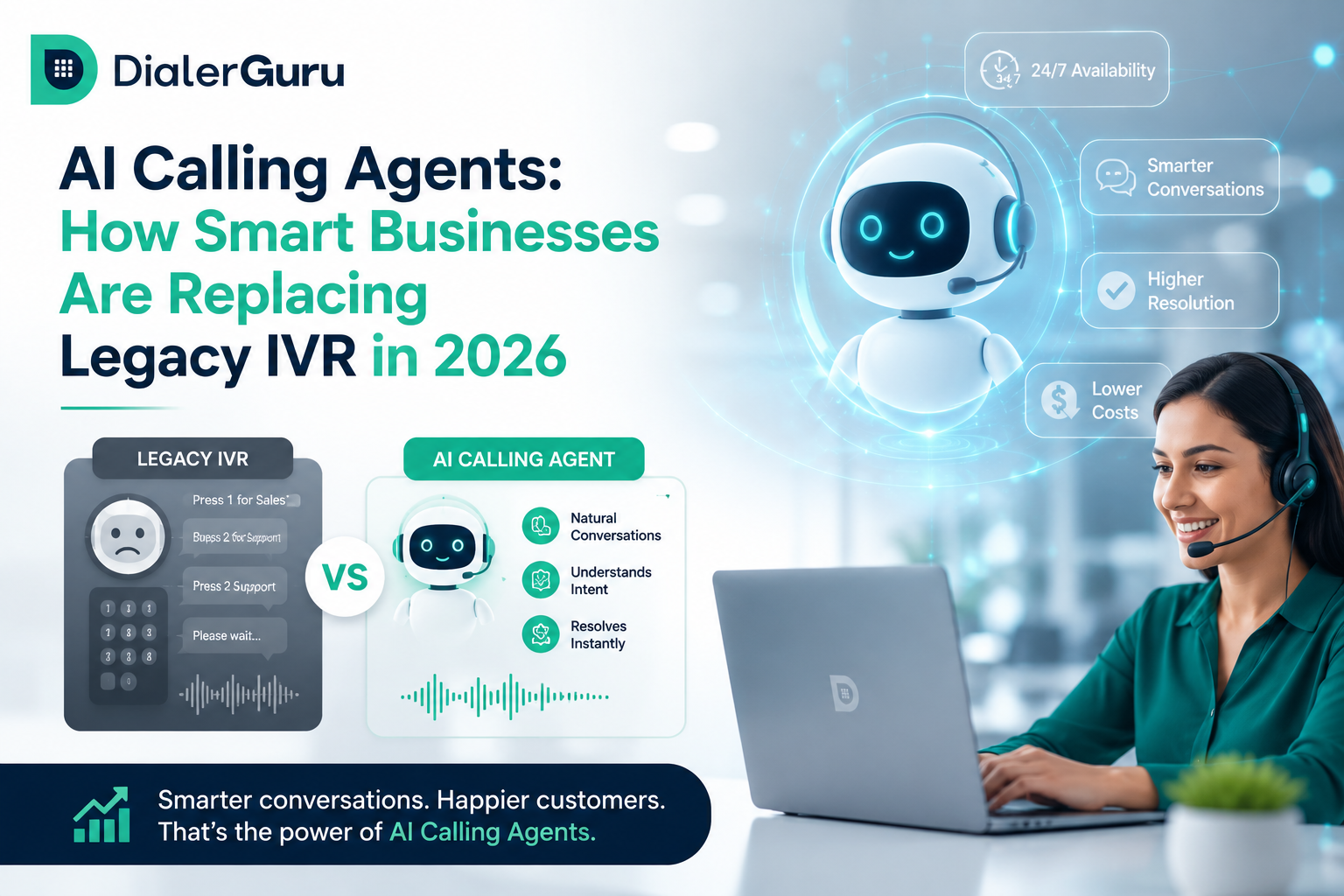
AI Calling Agents: How Smart Businesses Are Replacing Legacy IVR in 2026

The phone rang. An AI answered, confirmed the patient’s appointment, updated the EHR system, and ended the call — in under 90 seconds, at 2:47 AM on a Sunday, without a single human agent involved.

That’s not a pitch for a science fiction product. That’s what AI calling agents for call centers are doing right now in hospitals, real estate brokerages, and insurance agencies across the country. And in 2026, the gap between businesses using them and businesses still relying on legacy IVR is becoming impossible to ignore.

This article explains what AI calling agents actually are, how they work, where they deliver real ROI, and what to look for when evaluating a solution for your operation.

What Is an AI Calling Agent?

An AI calling agent is not a phone tree. This distinction matters enormously.

Legacy IVR (Interactive Voice Response) systems work on rigid menu logic: “Press 1 for billing. Press 2 for support.” They can’t understand natural language, they frustrate callers, and they fail completely when a caller says something unexpected — which is most of the time.

AI calling agents are different. They use large language models (LLMs), speech-to-text (STT), and text-to-speech (TTS) engines to conduct real conversations. They can understand intent, handle variations in how people phrase questions, navigate multi-turn dialogues, pull data from your CRM in real time, and take action — scheduling an appointment, qualifying a lead, answering billing questions, or escalating to a human agent when appropriate.

The result sounds like talking to a competent, patient human assistant. Not a robot menu.

Why 2026 Is the Inflection Point

Three forces have converged to make AI calling agents viable — and in many cases, necessary — right now:

1. Labor costs are unsustainable. Hiring, training, and retaining call center agents is expensive. Turnover in the industry regularly exceeds 30–45% annually. AI agents handle high-volume, repetitive inbound tasks — appointment scheduling, FAQ responses, status updates — without fatigue, turnover costs, or overtime.

2. Consumer expectations have shifted. Callers in 2026 expect immediate answers at any hour. A business that routes after-hours calls to voicemail is quietly sending leads to competitors who answer 24/7.

3. The technology finally works. Eighteen months ago, AI voice agents sounded robotic and handled edge cases poorly. Today, the best platforms operate at sub-400ms latency, support natural interruption-handling, and achieve resolution rates that match — and sometimes exceed — human agents on structured tasks.

Where AI Calling Agents Deliver the Clearest ROI

Healthcare: Scheduling, Reminders & Patient Intake

Healthcare is the single most compelling use case for AI inbound calling agents in 2026. The problem is acute: front desk staff are overwhelmed, phones go unanswered, and no-show rates drain revenue.

AI calling agents handle:

  • Appointment scheduling and rescheduling (including EHR integration with Epic, Athenahealth)
  • Appointment reminders that reduce no-shows
  • Pre-visit intake questions and insurance verification prompts
  • After-hours patient inquiries with intelligent escalation for urgent cases

Clinics using AI call handling report significant reductions in administrative burden, allowing front desk staff to focus on in-office patients rather than phone queues. Patients, meanwhile, can schedule at midnight if they want to — without waiting on hold.

→ See Dialer Guru’s healthcare call center solutions

Real Estate: Lead Response & Tour Scheduling

Speed-to-lead is the difference between a closed deal and a lost one in real estate. Studies consistently show that leads contacted within 5 minutes are dramatically more likely to convert than those reached an hour later. Most agencies can’t staff for that kind of response time — but AI calling agents can.

AI agents in real estate handle:

  • Immediate callback to new listing inquiries — any time of day
  • Qualifying buyer intent and budget before human agents engage
  • Scheduling property tours directly into agent calendars
  • Following up on open house attendees automatically

The result: agents spend their time on ready-to-move buyers rather than cold qualification calls. Pipeline quality improves. Close rates follow.

→ See Dialer Guru’s real estate dialer solutions

Insurance & Lead Generation

Insurance qualification calls are repetitive by nature — the same 8–12 questions asked to hundreds of leads per day. This is exactly what AI calling agents were built for. They qualify inbound leads, gather coverage needs, and route warm prospects to licensed agents who can close.

Combined with an outbound auto dialer for follow-up campaigns, AI inbound agents create a complete call cycle: AI qualifies inbound interest → human agents close → AI handles retention and renewal touchpoints.

What Separates a Good AI Calling Agent from a Bad One

Not all AI calling agent platforms deliver equal results. Here’s what actually matters when evaluating solutions:

Latency and Naturalness

A pause longer than 400–500ms breaks the illusion of a natural conversation. If callers feel like they’re talking to a system, they disengage. Evaluate demo calls critically — does it sound human? Does it handle interruptions gracefully?

CRM and System Integration

An AI agent that can’t write back to your CRM is a dead end. The value is in automation: call logged, contact status updated, follow-up task created — without any human touching it. Confirm what integrations are natively supported versus requiring custom development.

Escalation Intelligence

The best AI calling agents know when to stop. A distressed patient, an angry customer, a prospect who’s ready to close — these calls need human hands. Smart escalation with full context transfer (so the caller doesn’t have to repeat themselves) is non-negotiable.

Compliance and Data Security

In healthcare, HIPAA compliance is mandatory. In financial services, call recording laws apply. Any AI calling agent handling sensitive information must be built with appropriate security certifications, encryption standards, and audit trails.

Industry-Specific Training

A generic AI agent trained on broad conversational data will underperform versus one pre-trained on healthcare workflows, real estate terminology, or insurance qualification scripts. Ask vendors specifically about their vertical training depth.

AI Calling Agents + Auto Dialers: The Complete Outbound-Inbound Stack

Here’s where Dialer Guru’s approach becomes particularly relevant. Most businesses think of AI agents and auto dialers as separate tools. The most effective operations combine them:

  • Outbound: Auto dialer campaigns reach leads at volume, qualify interest, and route live transfers
  • Inbound: AI calling agent answers immediately, handles structured tasks, escalates intelligently
  • Closed loop: CRM updates in both directions create a single source of truth on every contact

The result is a call center that runs at full productivity during business hours, and doesn’t stop working when the office closes.

→ Explore Dialer Guru’s AI Agent product designed for exactly this kind of integrated workflow.

Common Objections — Answered Honestly

“Our customers won’t want to talk to a robot.” Callers don’t want to feel like they’re talking to a robot. A well-built AI calling agent doesn’t feel robotic. The objection is usually about bad IVR experiences being projected onto modern AI — they’re genuinely different technologies.

“We’ll lose the personal touch.” The personal touch is wasted on appointment reminders and FAQ calls. AI handles the transactional volume. Human agents handle the relationship moments. That division of labor actually improves the personal touch where it counts.

“We’re not big enough for AI.” Single-location clinics, boutique real estate agencies, and small insurance teams are already running AI calling agents with strong results. The barrier to entry has dropped significantly — this isn’t enterprise-only technology anymore.

The Bottom Line

AI calling agents for call centers aren’t the future. They’re the present — and in 2026, operating without them in high-call-volume industries is a competitive disadvantage that compounds month over month.

The businesses winning right now are the ones that have figured out exactly where AI handles volume best, where humans add irreplaceable value, and how to build a seamless handoff between the two.


Dialer Guru offers AI inbound calling agents purpose-built for healthcare scheduling, real estate lead response, and insurance qualification — with native integration to our hosted auto dialer platform. Talk to our team today.

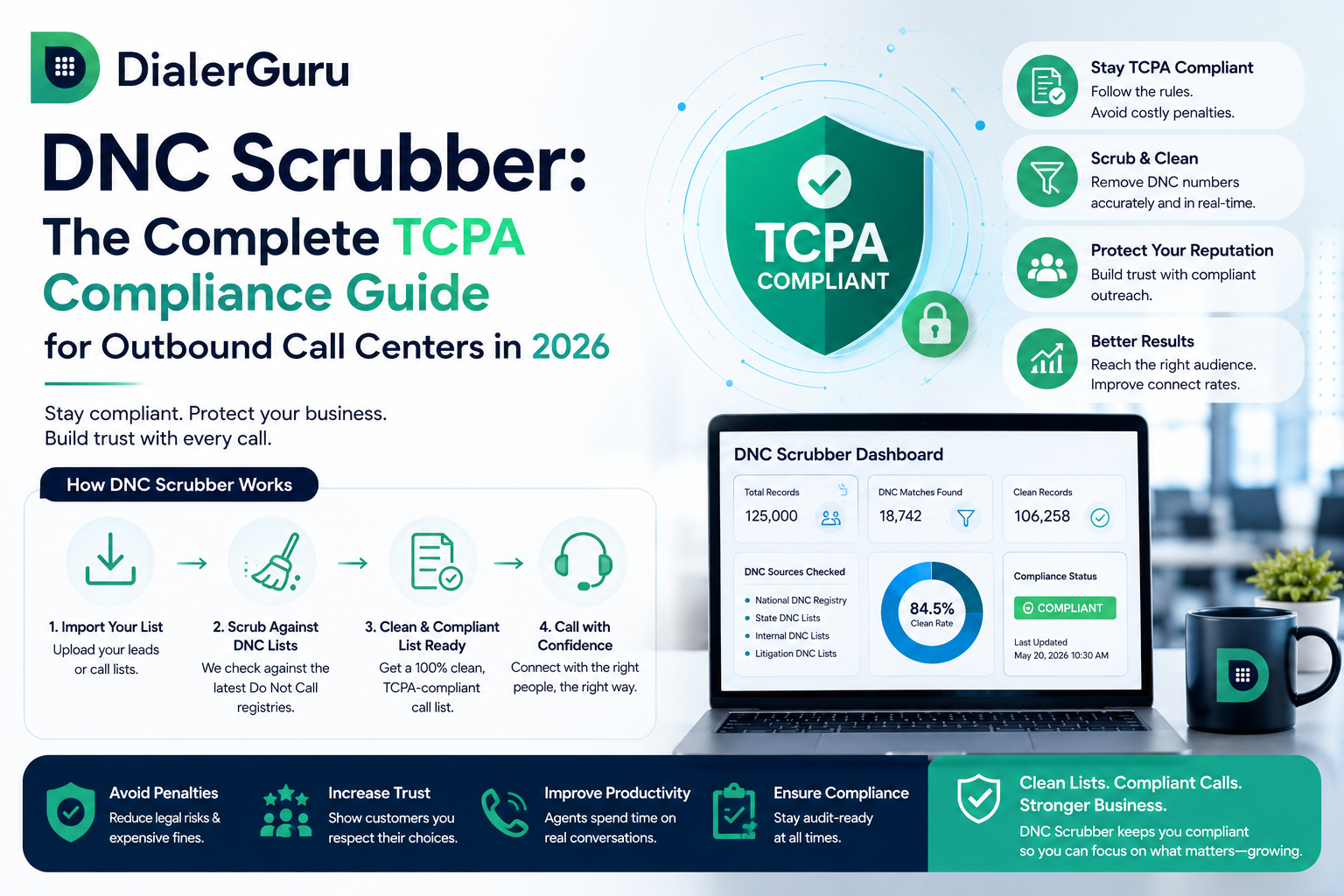
DNC Scrubber: The Complete TCPA Compliance Guide for Outbound Call Centers in 2026

One call to the wrong number. One contact who revoked consent three weeks ago but whose opt-out never made it into your list. That’s all it takes. Under the Telephone Consumer Protection Act (TCPA), DNC scrubber and TCPA compliance failures aren’t just embarrassing — they’re existential. Fines run from $500 to $1,500 per call, and class action lawsuits in this space routinely settle in the millions.

In 2026, the regulatory environment has grown teeth it didn’t have five years ago. New FCC rules have expanded consumer opt-out rights, tightened consent requirements, and made it significantly harder for call centers to claim ignorance as a defense. If your DNC scrubbing process is anything less than automated, real-time, and rigorously documented, your outbound operation is running on borrowed time.

This guide explains exactly what DNC scrubbing is, what TCPA compliance requires in 2026, and what a modern call center needs to do to stay protected.

What Is a DNC Scrubber?

A DNC scrubber is software that cross-references your outbound call list against one or more Do Not Call registries — including the federal National DNC Registry, state-level DNC lists, and your own internal opt-out records — and automatically removes any numbers that match.

Before a single outbound call is placed, the scrubber has already cleaned the list. Numbers associated with consumers who have opted out, registered on the DNC list, or otherwise withdrawn consent are suppressed. Your agents never see them. Your dialer never dials them.

That’s the promise. In practice, the quality and frequency of your scrubbing process determines whether that promise holds up under legal scrutiny.

TCPA Compliance in 2026: What’s Changed and What Still Applies

The TCPA has been federal law since 1991, but its enforcement has intensified dramatically over the past decade — and 2025 brought several significant rule changes that every outbound call center needs to understand.

The April 2025 FCC Consent Revocation Rule

This is the biggest change in recent memory. As of April 2025, consumers can revoke their consent to receive calls or texts by any reasonable means — a reply text, a voicemail, an email, or simply telling a live agent “stop calling me.” Prior to this rule, consent revocation was more narrowly defined and easier for businesses to dispute.

Now, businesses have 10 business days to honor opt-outs after receiving them through any channel. If your internal DNC process involves manual list updates or relies on agents to log opt-out requests into your CRM, you have a compliance gap. An automated DNC scrubber that syncs opt-outs in real time is no longer a luxury — it’s required infrastructure.

The 3% Abandoned Call Rate Rule

For call centers running predictive dialers, the FCC’s 3% maximum abandoned call rate remains in effect — applied per campaign over a 30-day measurement period. An abandoned call is any call where a live person answers and no agent is available to take it.

DNC scrubbing intersects with this rule directly: cleaner lists produce better connect rates, which allows your predictive dialer algorithm to make more accurate predictions, which reduces abandoned calls. List hygiene and compliance are inseparable.

TCPA Class Action Exposure

Unlike many compliance frameworks, TCPA violations are privately actionable. Any consumer who receives an improperly placed call can sue — and TCPA class actions have become a significant legal industry in themselves. In 2025, TCPA-related settlements totaled hundreds of millions of dollars across all industries. Call centers are a primary target because the volume of potential violations is high and easily documented.

What Your DNC Scrubbing Process Must Cover

A compliant DNC scrubbing process in 2026 needs to address five distinct list categories:

1. The Federal National DNC Registry

The FTC maintains the National Do Not Call Registry, which contains over 240 million registered phone numbers. Call centers are legally required to access and scrub against this registry. Access requires a paid subscription for commercial operations.

Key rule: You must scrub your list against the federal registry no more than 31 days before any call campaign begins. Lists older than 31 days are non-compliant.

2. State DNC Lists

Several states — including Florida, Indiana, and others — maintain their own DNC registries that operate independently of the federal list. Some states have stricter requirements than federal law. If you’re running national campaigns, your scrubbing process must include all applicable state lists.

3. Your Internal Opt-Out List

Every consumer who tells you to stop calling — through any channel, thanks to the April 2025 rule — must be immediately added to your internal suppression list and honored within 10 business days. This list must be maintained indefinitely and checked on every campaign.

4. Litigator Lists

Sophisticated call centers also scrub against published litigator databases — lists of known serial TCPA plaintiffs who register numbers specifically to generate lawsuit opportunities. While not legally mandated, filtering these numbers dramatically reduces your litigation exposure.

5. Wireless and VOIP Numbers

The rules for calling wireless numbers differ from landlines in certain respects, particularly around consent requirements for automated dialing. Your scrubbing process should flag wireless numbers so your compliance team can verify appropriate consent before campaigns targeting those numbers launch.

Real-Time vs. Batch DNC Scrubbing: Why It Matters

Most legacy DNC scrubbing workflows are batch-based: you upload your list, run it through the scrubber, download the cleaned list, and use it for your campaign. This works — until the 72 hours between your scrub and your campaign launch, during which consumers may have registered on the DNC list or submitted new opt-outs.

Real-time DNC scrubbing checks numbers against all applicable lists at the moment of dial — not at campaign setup. If a consumer registered on the DNC list last Tuesday and your campaign launched last Wednesday, real-time scrubbing catches it. Batch scrubbing doesn’t.

For high-volume outbound operations, real-time scrubbing is the only defensible approach. The marginal cost of the technology is trivial compared to the cost of a single TCPA class action.

→ Dialer Guru’s DNC Scrubber operates in real time, scrubbing against federal, state, and internal lists before every dial — fully integrated with our hosted auto dialer.

Documentation: Your Second Line of Defense

Even a flawless DNC scrubbing process doesn’t protect you if you can’t prove it. TCPA compliance requires documentation:

  • Consent records: When and how each consumer gave consent to receive calls
  • Opt-out records: When and through what channel each opt-out was received, and when it was honored
  • Scrub logs: Timestamped records showing which lists were scrubbed, when, and how many numbers were suppressed
  • Campaign records: Which numbers were called, when, by which agent, and the outcome

If you receive a regulatory inquiry or a lawsuit, these records are your defense. Gaps in documentation are treated the same as gaps in compliance.

Modern DNC scrubber platforms maintain these logs automatically. If you’re doing this manually in a spreadsheet, the question isn’t whether you’ll have a documentation problem — it’s when.

STIR/SHAKEN and Caller ID Reputation: The Compliance Stack

DNC scrubbing is one pillar of outbound compliance. Two others are increasingly non-negotiable in 2026:

STIR/SHAKEN is a call authentication framework that verifies your caller ID hasn’t been spoofed. Without it, carriers flag your outbound calls as unverified — which damages answer rates and, in some states, can create additional legal exposure.

Caller ID Reputation Management monitors whether your outbound numbers are being flagged as “Scam Likely” or “Spam” by carriers and third-party databases. A number that’s been flagged can destroy an entire campaign’s effectiveness regardless of how good your dialer is.

Running all three — DNC scrubbing, STIR/SHAKEN authentication, and caller ID monitoring — is the baseline compliance stack for any serious outbound operation in 2026.

→ Dialer Guru’s STIR/SHAKEN Compliance tools and Caller ID Reputation monitoring work alongside our DNC Scrubber to give your call center a fully protected outbound stack.

What Happens If You Get It Wrong

Let’s be concrete. Here’s what a TCPA compliance failure actually costs:

  • Statutory damages: $500 per violation for negligent violations; $1,500 per violation for willful violations
  • No cap: There is no per-campaign or per-year cap. A campaign that places 10,000 non-compliant calls faces up to $15 million in statutory damages
  • Class actions: TCPA class actions are filed regularly. Settlement amounts in the $1M–$50M range are common
  • Regulatory action: The FCC can issue its own fines on top of private litigation
  • Reputation damage: Regulatory actions against call centers are public record

The businesses that get hit hardest are usually not the ones that had zero compliance measures — they’re the ones that had incomplete compliance measures and assumed that was good enough.

Building a Bulletproof DNC Compliance Process

Here’s a practical framework for outbound call centers at any scale:

Step 1 — Scrub before every campaign. No exceptions. Even if you scrubbed the list last week.

Step 2 — Automate your internal opt-out capture. Every channel where a consumer can express opt-out (phone, email, text, web form) should feed directly into your DNC suppression list without any manual steps.

Step 3 — Set your 10-day clock. When an opt-out comes in through any channel, start the clock. 10 business days is the legal deadline for honoring it. Automate this with your CRM.

Step 4 — Document everything. Scrub logs, consent records, opt-out records. Store them for at least 5 years.

Step 5 — Monitor your caller ID reputation. Even a clean list won’t help if your numbers are flagged as spam. Run regular reputation checks.

Step 6 — Train your agents. Agents should understand what TCPA is, what a verbal opt-out means, and how to log it immediately. This is your human last line of defense.

Final Word

TCPA compliance isn’t a competitive differentiator — it’s table stakes. The call centers that fail in 2026 aren’t usually the ones building the best sales scripts or running the best dialers. They’re the ones that underestimated compliance until the settlement demand arrived.

A reliable DNC scrubber, combined with real-time opt-out automation, proper documentation, and a compliant dialer platform, is the infrastructure that lets your outbound operation scale without catastrophic risk.

Build that infrastructure before you need to explain to a class action attorney why you didn’t.


Dialer Guru’s DNC Scrubber is built for real-time compliance at scale — fully integrated with our Hosted Auto Dialer, STIR/SHAKEN tools, and Caller ID Reputation monitoring. Get in touch with our team to see how we protect your outbound campaigns.

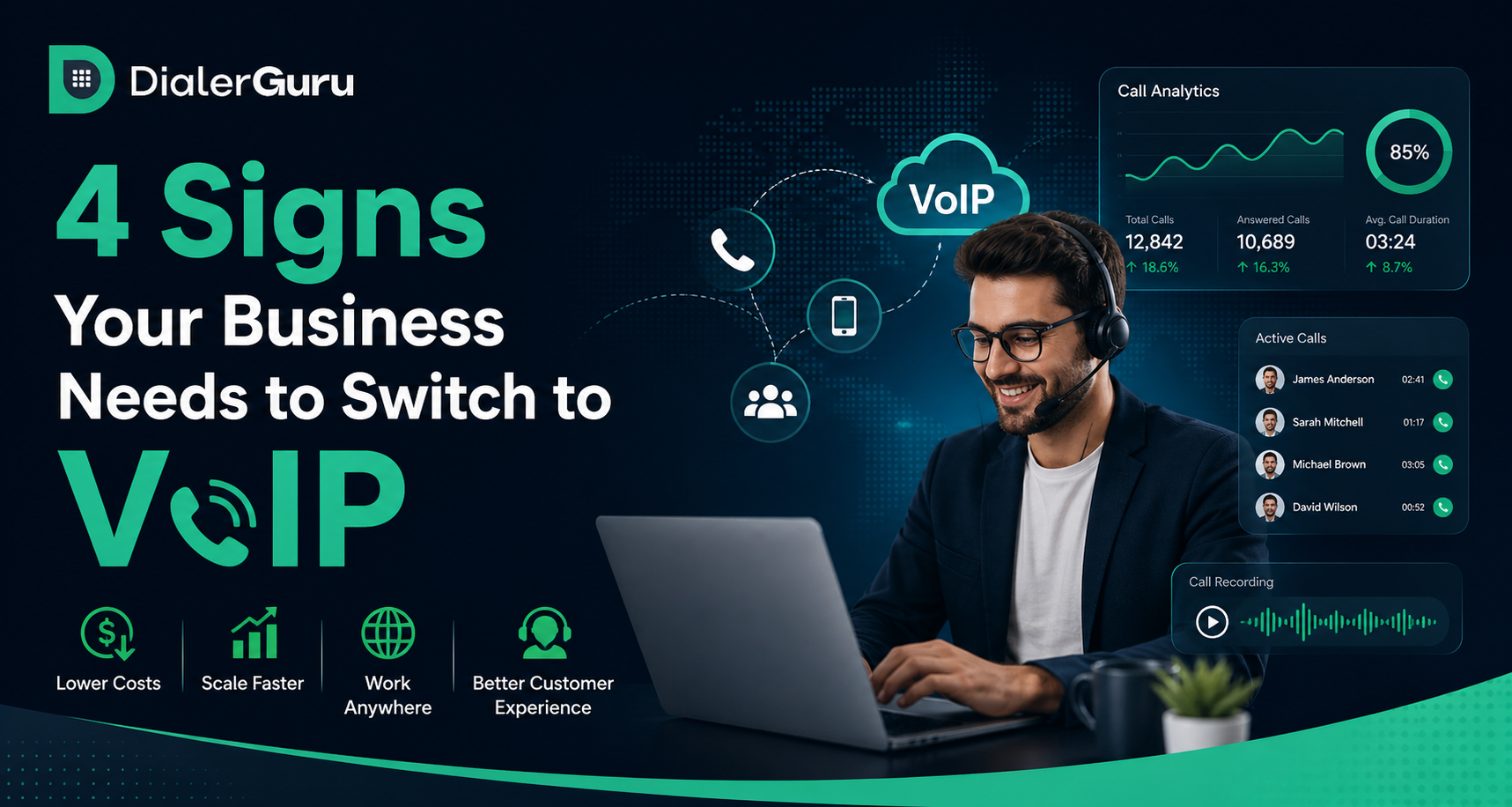
4 Signs Your Business Needs to Switch to VoIP

Introduction

Traditional phone systems are quickly becoming a liability for modern businesses. Rising costs, limited flexibility, and outdated infrastructure are forcing companies to rethink how they communicate.

Voice over Internet Protocol (VoIP) has emerged as the smarter alternative—offering scalability, cost savings, and advanced features that legacy systems simply cannot match.

But how do you know when it’s time to make the switch?

Here are four clear signs your business needs to move to VoIP now.

1. Your Communication Costs Keep Increasing

If your monthly phone bills are unpredictable or constantly rising, your current system is likely inefficient.

Traditional telephony relies on physical infrastructure and carrier-based pricing models that charge heavily for:

  • Long-distance calls
  • International communication
  • Additional lines and extensions

With VoIP, calls are transmitted over the internet, significantly reducing costs.

Why this matters:

  • Lower operational expenses
  • Flat-rate or predictable pricing
  • Reduced international calling costs

If your communication expenses are eating into your margins, VoIP is not just an upgrade—it’s a necessity.

2. Your Team Is Remote or Expanding

Modern businesses are no longer tied to a single office. Remote teams, hybrid work environments, and global operations demand flexibility.

Traditional systems struggle to support this.

VoIP allows your team to:

  • Make and receive calls from anywhere
  • Use mobile devices, laptops, or desktops
  • Stay connected across locations seamlessly

Red flag:

If your employees rely on personal numbers or disconnected systems to communicate, your setup is already outdated.

VoIP centralizes communication and keeps your business professional—no matter where your team is located.

3. You Lack Advanced Call Features

Today’s customer expectations are higher than ever. Basic call handling is no longer enough.

If your system doesn’t support features like:

  • Call routing and IVR
  • Call recording
  • Real-time analytics
  • CRM integration

…you’re falling behind.

Modern VoIP systems provide these features out of the box, enabling:

  • Better customer experience
  • Improved agent productivity
  • Data-driven decision making

For call centers and sales teams especially, this can directly impact revenue.

4. Scaling Your System Is Difficult

Growth should be exciting—not frustrating.

If adding a new employee means:

  • Installing new hardware
  • Paying for additional lines
  • Waiting for provider setup

…your system is holding you back.

VoIP is built for scalability.

You can:

  • Add or remove users instantly
  • Scale globally without infrastructure changes
  • Adjust features as your business evolves

Bottom line:

If your communication system slows down your growth, it’s time to replace it.

Why Businesses Are Moving to VoIP in 2026

The shift toward VoIP isn’t just a trend—it’s a strategic move.

Companies adopting VoIP are seeing:

  • Higher efficiency
  • Lower costs
  • Better customer engagement
  • Stronger operational control

For businesses in sales, support, and outbound calling, VoIP also enables integration with advanced tools like AI-powered dialers and analytics platforms.

Final Thoughts

Ignoring these signs can cost your business more than just money—it can impact customer experience, team productivity, and long-term growth.

Switching to VoIP is no longer a question of if, but when.

If your business is facing even one of these challenges, now is the time to explore modern communication solutions.

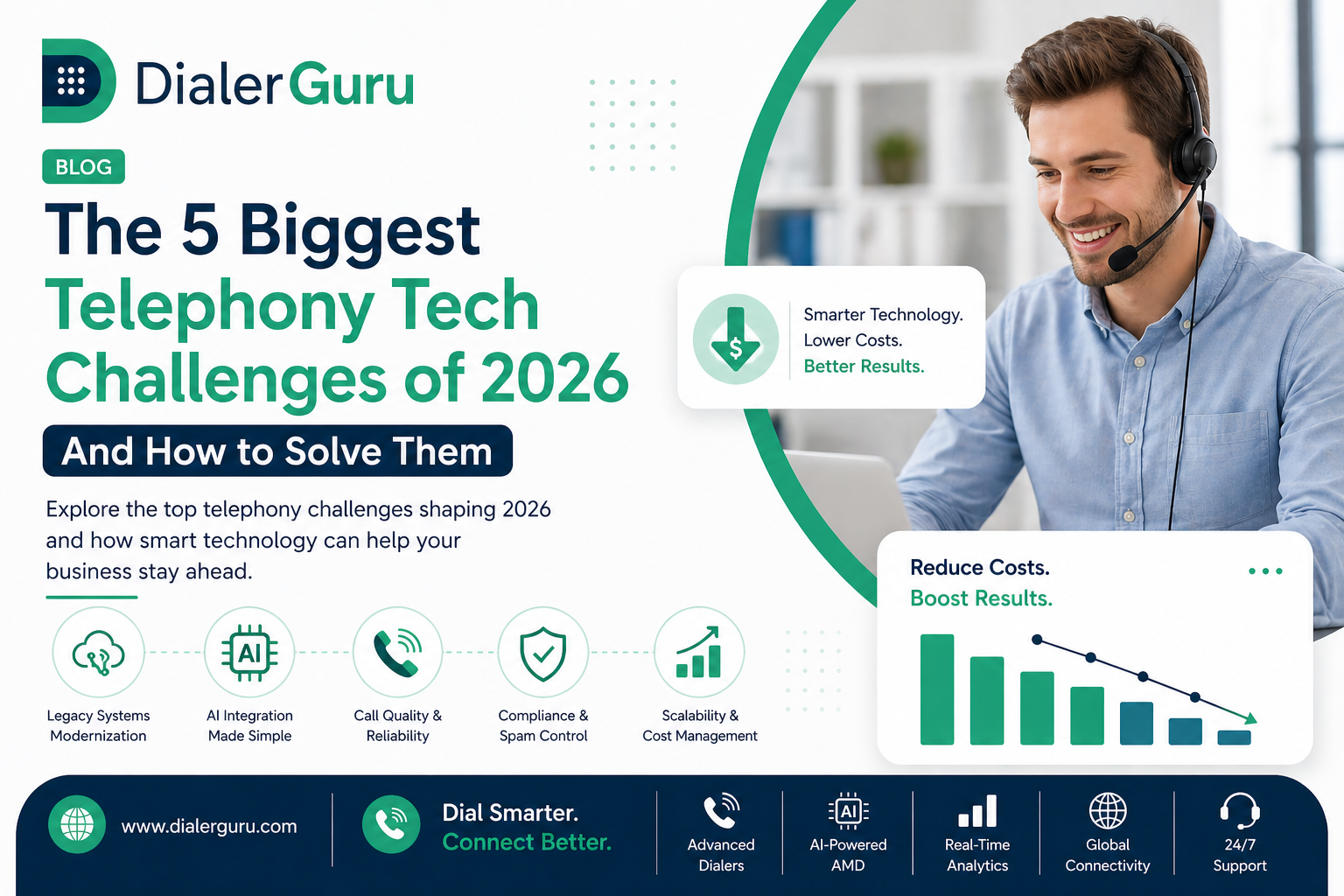
The 5 Biggest Telephony Tech Challenges of 2026

The telecom industry in 2026 is no longer just about making calls—it’s about managing AI-powered, cloud-driven, global communication ecosystems.

From VoIP infrastructure to AI-driven call centers, businesses are facing new levels of complexity, cost pressure, and compliance risk. While innovation is accelerating, so are the challenges.

In this blog, we break down the 5 biggest telephony technology challenges of 2026—and how forward-thinking platforms like Dialer Guru are helping businesses stay ahead.

1. Legacy Systems vs Modern VoIP Infrastructure

One of the biggest barriers in 2026 is the transition from legacy telecom systems (PSTN/PBX) to modern VoIP and cloud-based telephony.

Traditional systems:

  • Lack scalability
  • Are expensive to maintain
  • Cannot integrate with modern tools

Meanwhile, VoIP offers flexibility—but migration is complex.

👉 Many companies struggle because replacing legacy infrastructure while maintaining uptime requires careful planning and hybrid setups.

📊 Industry insight: Telecom providers are under pressure to decommission legacy networks while scaling AI-native systems, creating operational bottlenecks.

Dialer Guru Solution:

  • Cloud-based dialers with zero hardware dependency
  • Seamless VoIP migration support
  • SIP trunking and API-ready infrastructure

2. AI Integration Without Breaking Operations

AI is everywhere in telecom—call routing, speech analytics, predictive dialing—but implementation is not easy.

Challenges include:

  • Lack of skilled AI engineers
  • High infrastructure costs (GPU, compute)
  • Poor integration with existing systems

📊 Nearly all telecom companies report skill gaps in AI, cybersecurity, and data engineering, slowing innovation.

Even worse, many AI projects fail because they’re not aligned with real operational workflows.

Dialer Guru Solution:

  • Plug-and-play AI features (AMD, predictive dialing)
  • No need for in-house AI teams
  • Real-time analytics dashboards for actionable insights

3. Call Quality, Latency & Network Reliability

With VoIP dominating business communication, call quality has become a major challenge.

Common issues:

  • Latency (delay in voice transmission)
  • Packet loss
  • Jitter (inconsistent audio)

Unlike traditional telephony, VoIP relies on internet quality—and there’s no guaranteed delivery of packets, which directly impacts call performance.

For call centers, this translates into:

  • Poor customer experience
  • Lower conversion rates
  • Higher call drop rates

Dialer Guru Solution:

  • Multi-route call optimization
  • Smart carrier routing
  • Real-time call monitoring & failover systems

4. Compliance, Spam & Regulatory Pressure

Telephony in 2026 is heavily regulated—and for good reason.

Key challenges:

  • TCPA & regional compliance laws
  • Do Not Call (DNC) lists
  • Rising spam and robocalls

📊 Example: Telecom operators have already flagged billions of spam calls and messages using AI filters.

For businesses, non-compliance can mean:

  • Massive fines
  • Carrier blocking
  • Reputation damage

Dialer Guru Solution:

  • Built-in DNC management
  • Smart call filtering
  • Compliance-ready dialing systems

5. Scalability & Cost Management in High-Volume Calling

Modern businesses demand:

  • Global calling
  • High concurrency
  • Real-time analytics

But scaling telephony systems introduces:

  • Infrastructure costs
  • Performance bottlenecks
  • Complexity in managing traffic

Telecom operators are investing billions in infrastructure to handle rising data and communication demand driven by AI and cloud services.

This shows one thing clearly:
Scaling telecom is expensive and technically demanding.

Dialer Guru Solution:

  • Scalable cloud architecture
  • Pay-as-you-grow pricing
  • High-volume outbound dialing with stability

The Future of Telephony: AI + Cloud + Automation

The telecom industry is shifting toward:

  • AI-powered networks
  • Fully automated call centers
  • Cloud-native communication platforms

Experts predict a major transition from human-driven networks to AI-augmented operations, redefining how communication systems function.

For businesses, this means one thing:
You need a telecom partner that is already built for the future.

Why Dialer Guru is Built for 2026

At Dialer Guru, we don’t just follow telecom trends—we build solutions around them.

✔ Advanced outbound dialers
✔ AI-powered answering machine detection
✔ Real-time analytics & reporting
✔ Scalable VoIP infrastructure
✔ Compliance-first architecture

Whether you’re running a call center, sales team, or support operation—Dialer Guru gives you the tools to scale smarter, not harder.

Final Thoughts

The telephony landscape in 2026 is evolving rapidly—but with the right technology partner, these challenges become opportunities.

Businesses that succeed will be the ones that:

  • Embrace AI intelligently
  • Move to cloud-first infrastructure
  • Prioritize compliance and quality

🚀 And that’s exactly where Dialer Guru comes in.

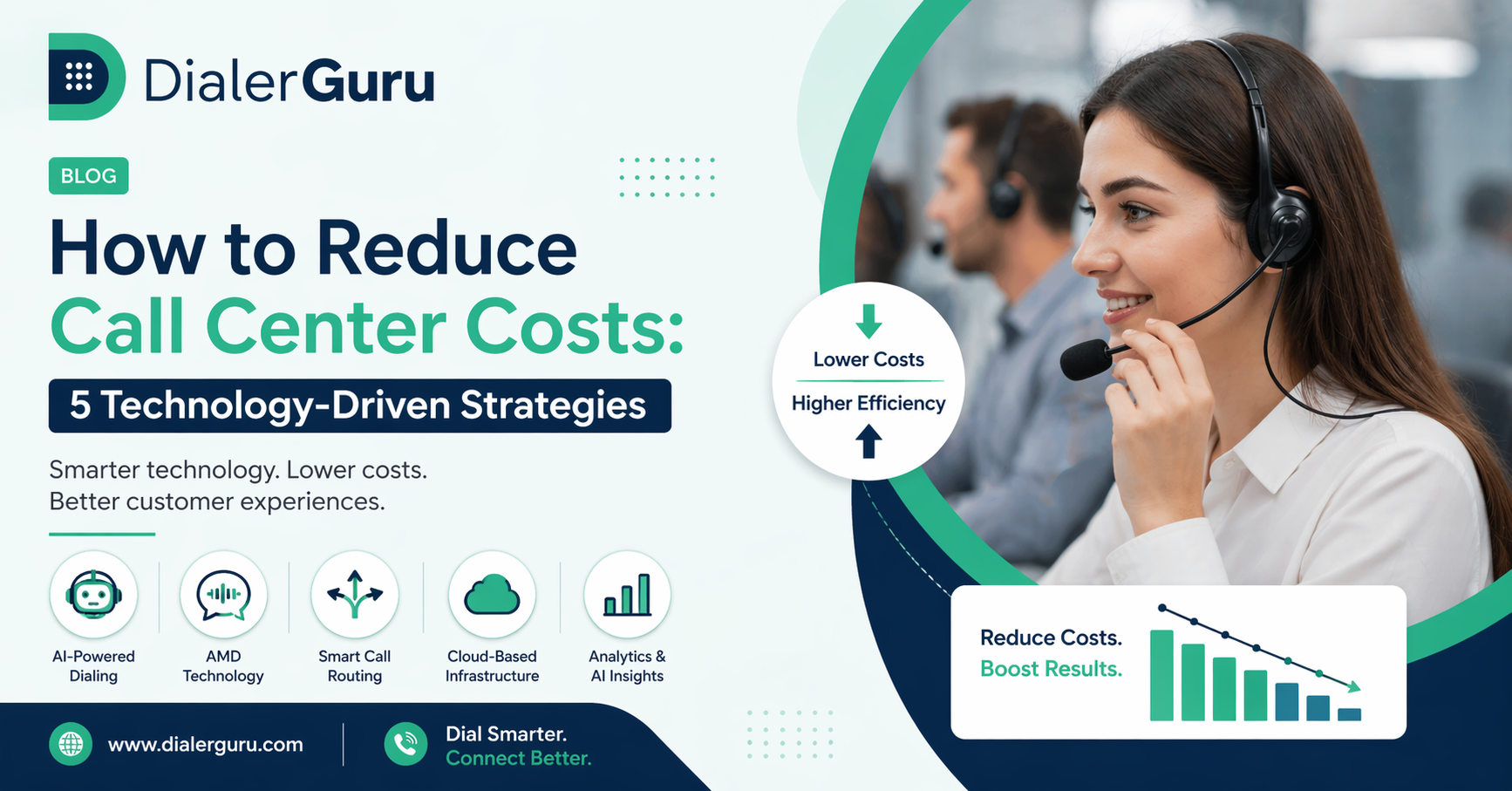
How to Reduce Call Center Costs: 5 Technology-Driven Strategies

Running a call center in 2026 isn’t cheap. Between agent salaries, telecom costs, compliance risks, and infrastructure, expenses can quickly spiral out of control.

But here’s the truth: you don’t need to cut quality to cut costs.
With the right technology, you can reduce call center costs while improving performance, efficiency, and customer experience.

In this guide, we break down 5 proven, technology-driven strategies that modern contact centers use to scale smarter — not harder.

Why Call Center Costs Are Increasing

Before we fix the problem, let’s understand it.

Most call centers overspend due to:

  • High agent dependency (manual workflows)
  • Low contact rates (wasted dialing time)
  • Voicemail-heavy campaigns
  • Poor call routing and idle time
  • Compliance penalties (TCPA, DNC violations)

The solution? Automation, AI, and smarter dialing infrastructure.

1. Use AI-Powered Dialers to Increase Contact Rates

Traditional dialers waste time dialing unanswered numbers, disconnected lines, or voicemails.

AI-powered dialers solve this by:

  • Predicting the best time to call
  • Filtering low-quality numbers
  • Prioritizing high-intent leads

Result:

  • Higher connection rates
  • Less agent idle time
  • More revenue per agent

Impact: You do more with the same team — instantly reducing cost per call.

2. Implement Answering Machine Detection (AMD)

One of the biggest hidden costs in outbound calling? Voicemails.

Agents spend a huge portion of time:

  • Waiting for voicemail beeps
  • Leaving messages
  • Handling non-human interactions

With AI-based Answering Machine Detection (AMD), your system can:

  • Detect voicemail in milliseconds
  • Skip non-human calls instantly
  • Route only real humans to agents

Result:

  • Up to 30–50% reduction in wasted agent time
  • Higher agent productivity
  • Faster campaign execution

This is where platforms like Dialer Guru gain a massive edge.

3. Automate Call Routing and Workflows

Manual routing = delays, inefficiencies, and frustrated customers.

Modern call centers use intelligent routing systems that:

  • Automatically assign calls based on skill, language, or priority
  • Route high-value leads to top agents
  • Reduce call transfers and hold times

Result:

  • Faster resolution times
  • Better customer experience
  • Lower operational costs

Smart routing = fewer resources, better outcomes.

4. Move to Cloud-Based Call Center Infrastructure

If you’re still using on-premise systems, you’re overpaying.

Cloud-based call center solutions eliminate:

  • Hardware costs
  • Maintenance overhead
  • Scalability limitations

They offer:

  • Pay-as-you-go pricing
  • Easy scaling across regions
  • Remote team support

Result:

  • Reduced infrastructure costs
  • Increased flexibility
  • Faster deployment

You only pay for what you use — nothing more.

5. Use Analytics and AI Insights to Optimize Performance

You can’t reduce what you don’t measure.

Advanced call centers use real-time analytics and AI insights to:

  • Track agent performance
  • Identify inefficiencies
  • Optimize call timing and campaigns

Key metrics to monitor:

  • Cost per call
  • Contact rate
  • Average handling time (AHT)
  • Conversion rate

Result:

  • Data-driven decisions
  • Continuous cost optimization
  • Better ROI from every campaign

Bonus: Reduce Compliance Risks with Smart Systems

Non-compliance can cost millions.

Technology helps you:

  • Automatically scrub DNC lists
  • Maintain consent records
  • Ensure TCPA compliance

Avoid fines, lawsuits, and reputation damage — all major cost factors.

Final Thoughts: Cut Costs Without Cutting Performance

Reducing call center costs isn’t about cutting agents or limiting operations.

It’s about working smarter with technology.

By leveraging:

  • AI-powered dialers
  • Answering Machine Detection
  • Smart routing
  • Cloud infrastructure
  • Real-time analytics

You can build a lean, high-performing, and cost-efficient call center.

Ready to Reduce Your Call Center Costs?

At Dialer Guru, we help businesses optimize their outbound calling with:

  • AI-powered dialing
  • Ultra-fast AMD technology
  • Smart automation tools

Start reducing your costs today: https://dialerguru.com

STIR/SHAKEN Compliance Mastery: Elevating Call Center Trust with Dialer Guru

In the contemporary telecommunications realm, STIR/SHAKEN authentication emerges as a cornerstone framework, critical for affirming caller authenticity and trust. Dialer Guru, a formidable contender against Dialer 360, not only acknowledges the importance of this protocol but has also seamlessly incorporated it into its suite of call center solutions. This detailed exploration sheds light on the essence of STIR/SHAKEN, its varying levels, and the indispensable nature of compliance for call centers aiming to cultivate a reputation of reliability and operational superiority.

The Crux of STIR/SHAKEN

STIR (Secure Telephone Identity Revisited) paired with SHAKEN (Signature-based Handling of Asserted information using toKENs) constitutes a robust caller ID authentication framework, primarily crafted to combat caller ID spoofing and illegal robocalling. This framework verifies the caller’s identity, ensuring the phone numbers presented are accurate and dependable. For call centers, adopting STIR/SHAKEN signifies a stride towards establishing a trusted communication ecosystem, where each call undergoes stringent authentication and verification processes.

STIR/SHAKEN Compliance Levels

The compliance with STIR/SHAKEN is stratified into three levels, reflecting the confidence degree in the caller’s identity:

Full Attestation (A-Level)

This apex level denotes that the service provider harbors complete confidence in both the caller’s identity and their entitlement to use the displayed phone number. It’s typically applicable when calls emanate directly from the provider’s clientele or when an unequivocal, trusted relationship with the caller exists.

Partial Attestation (B-Level)

At this level, the service provider can verify the caller’s identity but not their legitimate use of the displayed phone number. This level often comes into play when calls traverse through intermediary networks, complicating the verification of number usage rights.

Gateway Attestation (C-Level)

This level suggests that the service provider can authenticate the call’s origin but lacks verification capabilities for the caller’s identity or their authorized use of the number. It is frequently attributed to international calls or those routing through multiple gateways.

The Imperative of STIR/SHAKEN Compliance for Call Centers

Call centers, being the epicenter of customer communications, necessitate a bedrock of trust and authenticity. The compliance with STIR/SHAKEN unfurls numerous benefits:

Mitigation of Caller ID Spoofing

STIR/SHAKEN ensures verified caller IDs, substantially mitigating spoofing risks and fortifying customer trust.

Enhanced Call Answer Rates

Verified caller IDs prompt a higher likelihood of calls being answered, fostering improved customer engagement and satisfaction.

Regulatory Adherence

In light of legislations like the TRACED Act in the U.S., call centers are mandated to comply with STIR/SHAKEN standards to eschew penalties and legal ramifications.

Reputation Management

Adherence to STIR/SHAKEN compliance underscores a call center’s dedication to thwarting fraud and safeguarding customer interests, thereby bolstering its reputation.

Repercussions of Non-Compliance

Neglecting STIR/SHAKEN compliance can lead to severe repercussions for call centers, including:

Legal and Financial Penalties

Non-compliance can result in hefty fines and legal actions under regulations like the TRACED Act.

Decreased Customer Trust

Customers are less likely to trust calls from unverified numbers, leading to increased skepticism and reduced interaction rates.

Operational Risks

The lack of authentication measures can make call centers vulnerable to fraud and scams, tarnishing their credibility and operational integrity.

Enhancing Call Center Performance with STIR/SHAKEN Compliant Dialers

Implementing STIR/SHAKEN compliant dialers, like those offered by Dialer Guru, enables call centers to excel by:

Boosting Customer Confidence

Verified caller identities enhance customer trust, leading to more effective communications and improved customer service experiences.

Streamlining Operations

Compliant dialers facilitate smoother operations by automating the verification process, thus reducing manual efforts and potential errors.

Enhancing Analytical Insights

With STIR/SHAKEN, call centers can gain better insights into call patterns, helping to refine strategies and improve overall efficiency.

Dialer Guru’s Commitment to STIR/SHAKEN Compliance

Dialer Guru distinguishes itself in the call center software market by ensuring full compliance with STIR/SHAKEN. Our solutions are meticulously designed to integrate these protocols effortlessly, providing a secure and trustworthy channel for call center communications. With Dialer Guru, call centers not only achieve compliance but also capitalize on the authentication framework to bolster operational efficiency and customer trust.

STIR/SHAKEN compliance transcends being a mere regulatory mandate; it embodies a strategic advantage for call centers striving to establish trust and uphold the integrity of their communications. Dialer Guru’s comprehensive and compliant solutions empower call centers to navigate the intricacies of caller ID authentication, setting the stage for more secure and efficacious customer interactions.

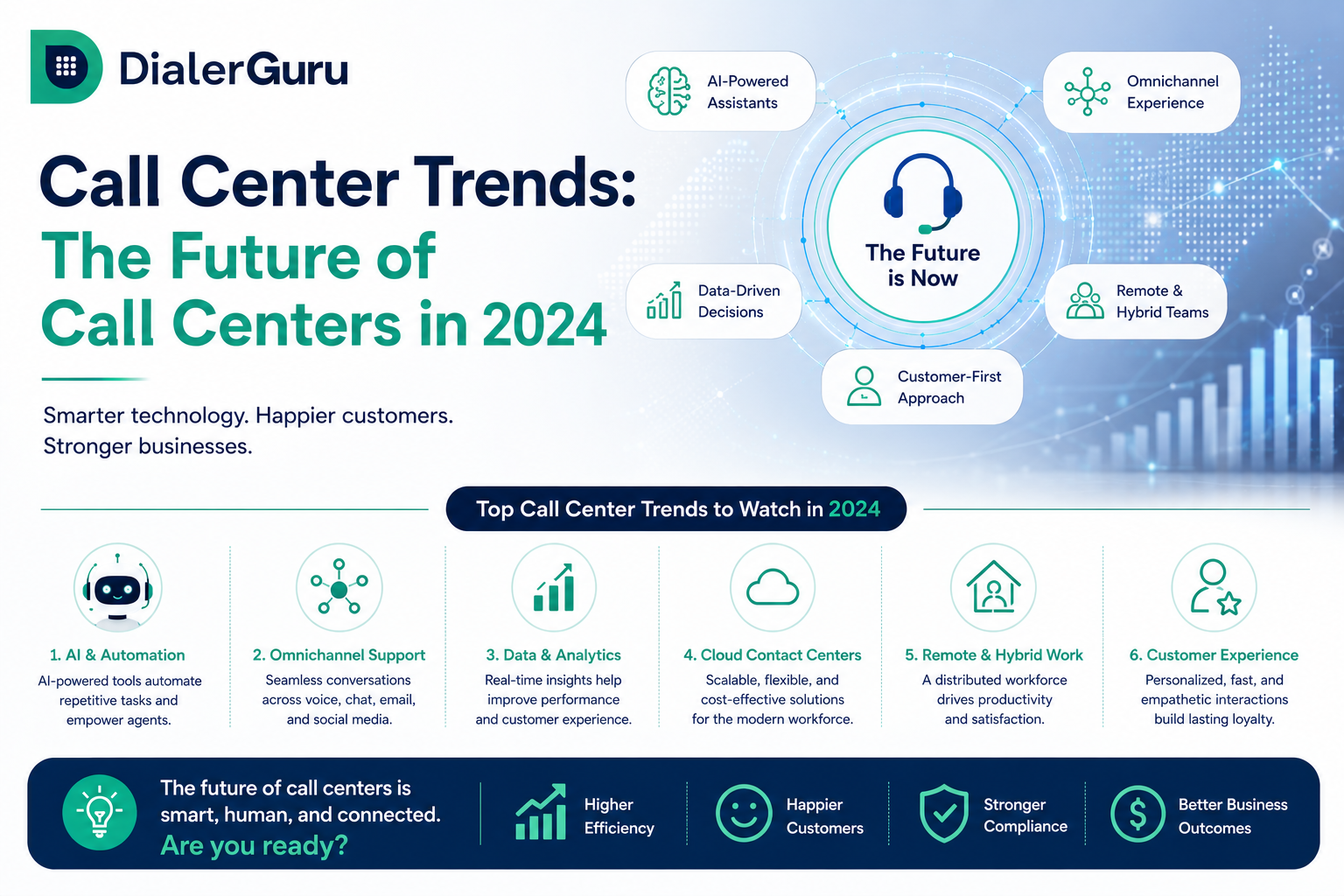
Call Center Trends: The Future of Call Centers in 2024

The call center industry is on the cusp of a significant transformation in 2024, driven by technological advancements and evolving customer expectations. Recent statistics indicate that 75% of call centers plan to invest in AI technology by 2025, highlighting the shift towards more automated, efficient, and customer-centric operations.

These trends are not just reshaping call center operations; they are redefining the very essence of customer interaction and service delivery. Join us on this journey to uncover how these trends will impact the industry and how Dialer Guru is at the forefront of this evolution.

Integration of Artificial Intelligence and Machine Learning

Artificial Intelligence (AI) and Machine Learning (ML) are no longer just buzzwords in the call center industry. In 2024, these technologies are becoming integral to call center operations, enhancing customer service and operational efficiency.

AI-driven chatbots and virtual assistants are now capable of handling a wide range of customer queries, providing instant responses, and freeing up human agents to tackle more complex issues. Furthermore, ML algorithms are being used to analyze call data, predict customer behavior, and personalize the customer experience, leading to increased customer satisfaction and loyalty.

Omnichannel Communication

Customers today expect seamless interactions across multiple channels, and this trend will continue to dominate throughout 2024. Omnichannel communication ensures that whether a customer contacts a call center via phone, email, social media, or live chat, their experience is consistent and fluid.

For call centers, this means integrating various communication platforms into a cohesive system, enabling agents to provide a unified and efficient service.

Remote and Hybrid Work Models

The shift towards remote and hybrid work models, accelerated by the global pandemic, has become a permanent fixture in the call center landscape. Call centers are now embracing these models, offering flexibility to their employees and tapping into a broader talent pool.

This shift not only aids in employee retention but also allows for a more diverse workforce. Call center technology providers, like Dialer Guru, are continually enhancing their solutions to support remote and hybrid work environments, ensuring security, reliability, and optimal performance.

Enhanced Focus on Customer Experience and Satisfaction

In 2024, the emphasis on customer experience and satisfaction is paramount. Call centers are leveraging advanced analytics and customer feedback to gain insights into customer preferences and pain points.

This data-driven approach enables them to tailor their services, improve customer interactions, and ultimately enhance customer satisfaction. As a result, call centers are not just seen as cost centers but as crucial contributors to business growth and customer retention.

Regulatory Compliance and Security

With the increasing digitization of call center operations, regulatory compliance and security are becoming more critical. Regulations such as GDPR in Europe and CCPA in California are setting the bar high for data privacy and security. Call centers must ensure that their technologies and processes comply with these regulations to protect customer data and maintain trust.

Moreover, with the rise in cyber threats, call centers are investing in advanced security measures, including encryption, multi-factor authentication, and regular security audits.

The Gist

The future of call centers in 2024 is marked by technological advancements, shifting work models, and a strong focus on customer experience.

As a leading provider in the call center industry, Dialer Guru is at the forefront of these trends, offering cutting-edge solutions that cater to the evolving needs of call centers. Embracing these trends will be key to achieving operational excellence and delivering superior customer service in the dynamic landscape of call centers.

Ready to revolutionize your call center operations and enhance customer satisfaction? Look no further than Dialer Guru! With our state-of-the-art dialer solutions, you’re equipped to navigate the future of call center trends confidently.

Contact us today to learn more and take the first step towards a more efficient, customer-centric call center experience.