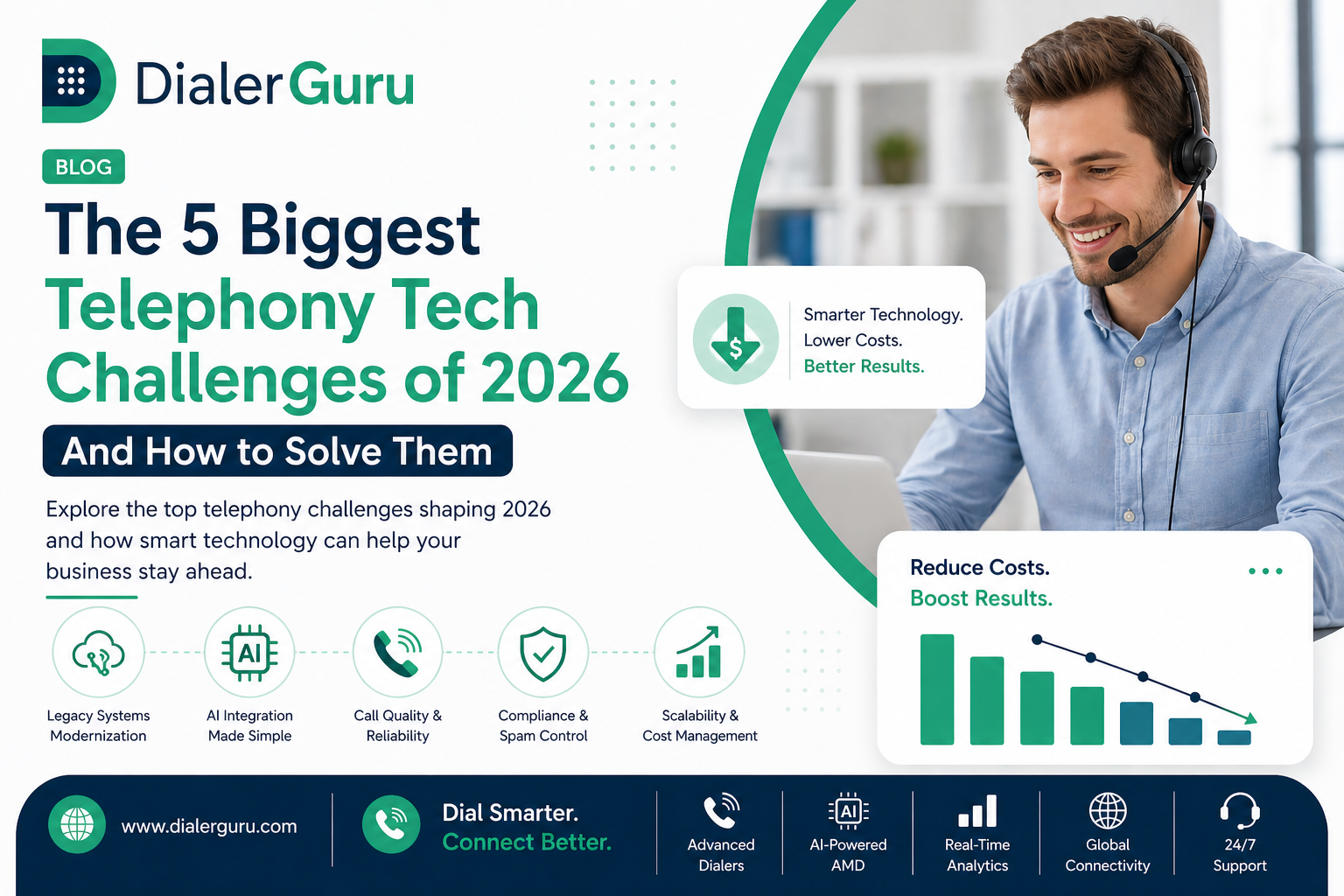
The telecom industry in 2026 is no longer just about making calls—it’s about managing AI-powered, cloud-driven, global communication ecosystems.
From VoIP infrastructure to AI-driven call centers, businesses are facing new levels of complexity, cost pressure, and compliance risk. While innovation is accelerating, so are the challenges.
In this blog, we break down the 5 biggest telephony technology challenges of 2026—and how forward-thinking platforms like Dialer Guru are helping businesses stay ahead.
1. Legacy Systems vs Modern VoIP Infrastructure
One of the biggest barriers in 2026 is the transition from legacy telecom systems (PSTN/PBX) to modern VoIP and cloud-based telephony.
Traditional systems:
- Lack scalability
- Are expensive to maintain
- Cannot integrate with modern tools
Meanwhile, VoIP offers flexibility—but migration is complex.
👉 Many companies struggle because replacing legacy infrastructure while maintaining uptime requires careful planning and hybrid setups.
📊 Industry insight: Telecom providers are under pressure to decommission legacy networks while scaling AI-native systems, creating operational bottlenecks.
Dialer Guru Solution:
- Cloud-based dialers with zero hardware dependency
- Seamless VoIP migration support
- SIP trunking and API-ready infrastructure
2. AI Integration Without Breaking Operations
AI is everywhere in telecom—call routing, speech analytics, predictive dialing—but implementation is not easy.
Challenges include:
- Lack of skilled AI engineers
- High infrastructure costs (GPU, compute)
- Poor integration with existing systems
📊 Nearly all telecom companies report skill gaps in AI, cybersecurity, and data engineering, slowing innovation.
Even worse, many AI projects fail because they’re not aligned with real operational workflows.
Dialer Guru Solution:
- Plug-and-play AI features (AMD, predictive dialing)
- No need for in-house AI teams
- Real-time analytics dashboards for actionable insights
3. Call Quality, Latency & Network Reliability
With VoIP dominating business communication, call quality has become a major challenge.
Common issues:
- Latency (delay in voice transmission)
- Packet loss
- Jitter (inconsistent audio)
Unlike traditional telephony, VoIP relies on internet quality—and there’s no guaranteed delivery of packets, which directly impacts call performance.
For call centers, this translates into:
- Poor customer experience
- Lower conversion rates
- Higher call drop rates
Dialer Guru Solution:
- Multi-route call optimization
- Smart carrier routing
- Real-time call monitoring & failover systems
4. Compliance, Spam & Regulatory Pressure
Telephony in 2026 is heavily regulated—and for good reason.
Key challenges:
- TCPA & regional compliance laws
- Do Not Call (DNC) lists
- Rising spam and robocalls
📊 Example: Telecom operators have already flagged billions of spam calls and messages using AI filters.
For businesses, non-compliance can mean:
- Massive fines
- Carrier blocking
- Reputation damage
Dialer Guru Solution:
- Built-in DNC management
- Smart call filtering
- Compliance-ready dialing systems
5. Scalability & Cost Management in High-Volume Calling
Modern businesses demand:
- Global calling
- High concurrency
- Real-time analytics
But scaling telephony systems introduces:
- Infrastructure costs
- Performance bottlenecks
- Complexity in managing traffic
Telecom operators are investing billions in infrastructure to handle rising data and communication demand driven by AI and cloud services.
This shows one thing clearly:
Scaling telecom is expensive and technically demanding.
Dialer Guru Solution:
- Scalable cloud architecture
- Pay-as-you-grow pricing
- High-volume outbound dialing with stability
The Future of Telephony: AI + Cloud + Automation
The telecom industry is shifting toward:
- AI-powered networks
- Fully automated call centers
- Cloud-native communication platforms
Experts predict a major transition from human-driven networks to AI-augmented operations, redefining how communication systems function.
For businesses, this means one thing:
You need a telecom partner that is already built for the future.
Why Dialer Guru is Built for 2026
At Dialer Guru, we don’t just follow telecom trends—we build solutions around them.
✔ Advanced outbound dialers
✔ AI-powered answering machine detection
✔ Real-time analytics & reporting
✔ Scalable VoIP infrastructure
✔ Compliance-first architecture
Whether you’re running a call center, sales team, or support operation—Dialer Guru gives you the tools to scale smarter, not harder.
Final Thoughts
The telephony landscape in 2026 is evolving rapidly—but with the right technology partner, these challenges become opportunities.
Businesses that succeed will be the ones that:
- Embrace AI intelligently
- Move to cloud-first infrastructure
- Prioritize compliance and quality
🚀 And that’s exactly where Dialer Guru comes in.