The phone rang. An AI answered, confirmed the patient’s appointment, updated the EHR system, and ended the call — in under 90 seconds, at 2:47 AM on a Sunday, without a single human agent involved.
That’s not a pitch for a science fiction product. That’s what AI calling agents for call centers are doing right now in hospitals, real estate brokerages, and insurance agencies across the country. And in 2026, the gap between businesses using them and businesses still relying on legacy IVR is becoming impossible to ignore.
This article explains what AI calling agents actually are, how they work, where they deliver real ROI, and what to look for when evaluating a solution for your operation.
What Is an AI Calling Agent?
An AI calling agent is not a phone tree. This distinction matters enormously.
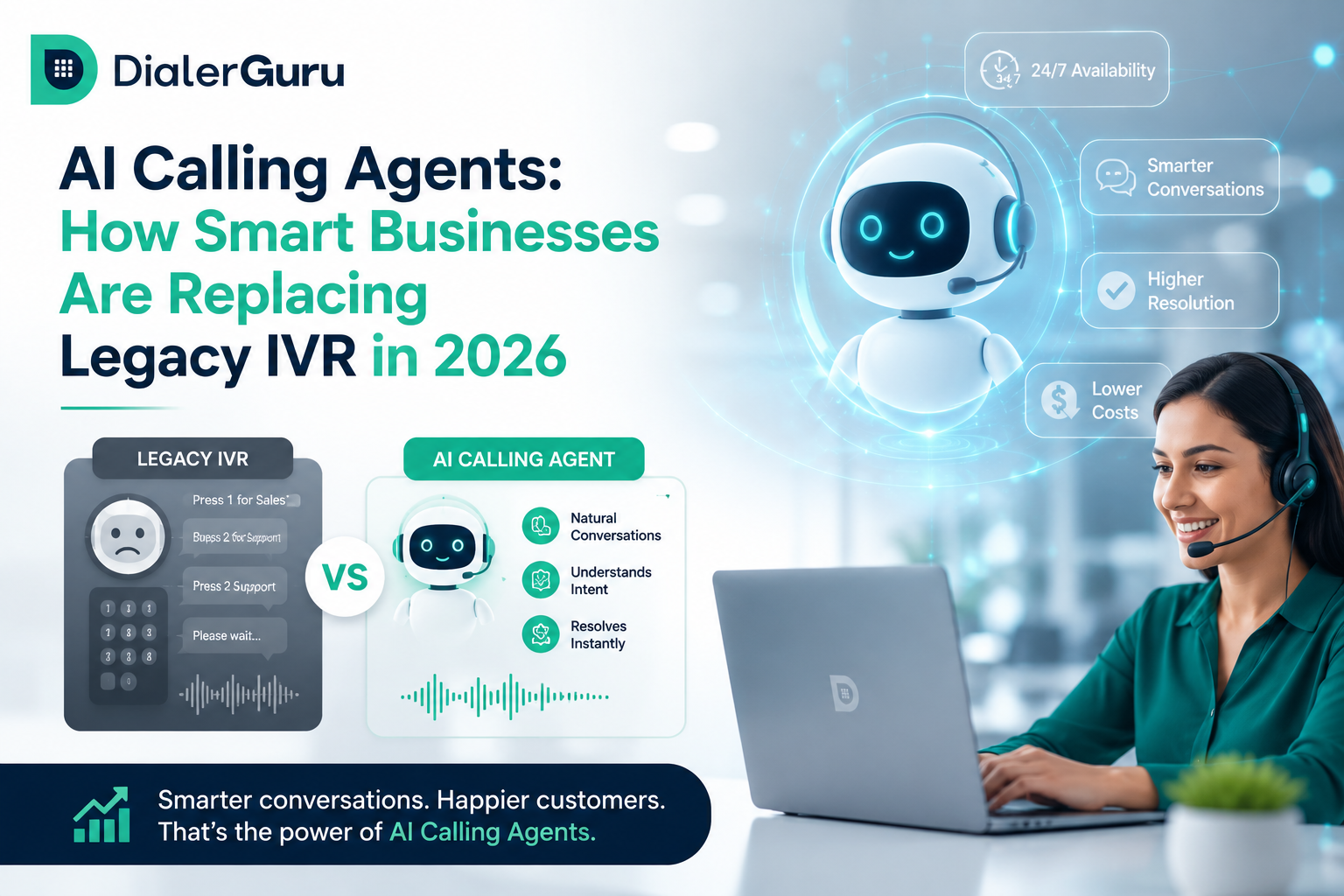
Legacy IVR (Interactive Voice Response) systems work on rigid menu logic: “Press 1 for billing. Press 2 for support.” They can’t understand natural language, they frustrate callers, and they fail completely when a caller says something unexpected — which is most of the time.
AI calling agents are different. They use large language models (LLMs), speech-to-text (STT), and text-to-speech (TTS) engines to conduct real conversations. They can understand intent, handle variations in how people phrase questions, navigate multi-turn dialogues, pull data from your CRM in real time, and take action — scheduling an appointment, qualifying a lead, answering billing questions, or escalating to a human agent when appropriate.
The result sounds like talking to a competent, patient human assistant. Not a robot menu.
Why 2026 Is the Inflection Point
Three forces have converged to make AI calling agents viable — and in many cases, necessary — right now:
1. Labor costs are unsustainable. Hiring, training, and retaining call center agents is expensive. Turnover in the industry regularly exceeds 30–45% annually. AI agents handle high-volume, repetitive inbound tasks — appointment scheduling, FAQ responses, status updates — without fatigue, turnover costs, or overtime.
2. Consumer expectations have shifted. Callers in 2026 expect immediate answers at any hour. A business that routes after-hours calls to voicemail is quietly sending leads to competitors who answer 24/7.
3. The technology finally works. Eighteen months ago, AI voice agents sounded robotic and handled edge cases poorly. Today, the best platforms operate at sub-400ms latency, support natural interruption-handling, and achieve resolution rates that match — and sometimes exceed — human agents on structured tasks.
Where AI Calling Agents Deliver the Clearest ROI
Healthcare: Scheduling, Reminders & Patient Intake
Healthcare is the single most compelling use case for AI inbound calling agents in 2026. The problem is acute: front desk staff are overwhelmed, phones go unanswered, and no-show rates drain revenue.
AI calling agents handle:
- Appointment scheduling and rescheduling (including EHR integration with Epic, Athenahealth)
- Appointment reminders that reduce no-shows
- Pre-visit intake questions and insurance verification prompts
- After-hours patient inquiries with intelligent escalation for urgent cases
Clinics using AI call handling report significant reductions in administrative burden, allowing front desk staff to focus on in-office patients rather than phone queues. Patients, meanwhile, can schedule at midnight if they want to — without waiting on hold.
→ See Dialer Guru’s healthcare call center solutions
Real Estate: Lead Response & Tour Scheduling
Speed-to-lead is the difference between a closed deal and a lost one in real estate. Studies consistently show that leads contacted within 5 minutes are dramatically more likely to convert than those reached an hour later. Most agencies can’t staff for that kind of response time — but AI calling agents can.
AI agents in real estate handle:
- Immediate callback to new listing inquiries — any time of day
- Qualifying buyer intent and budget before human agents engage
- Scheduling property tours directly into agent calendars
- Following up on open house attendees automatically
The result: agents spend their time on ready-to-move buyers rather than cold qualification calls. Pipeline quality improves. Close rates follow.
→ See Dialer Guru’s real estate dialer solutions
Insurance & Lead Generation
Insurance qualification calls are repetitive by nature — the same 8–12 questions asked to hundreds of leads per day. This is exactly what AI calling agents were built for. They qualify inbound leads, gather coverage needs, and route warm prospects to licensed agents who can close.
Combined with an outbound auto dialer for follow-up campaigns, AI inbound agents create a complete call cycle: AI qualifies inbound interest → human agents close → AI handles retention and renewal touchpoints.
What Separates a Good AI Calling Agent from a Bad One
Not all AI calling agent platforms deliver equal results. Here’s what actually matters when evaluating solutions:
Latency and Naturalness
A pause longer than 400–500ms breaks the illusion of a natural conversation. If callers feel like they’re talking to a system, they disengage. Evaluate demo calls critically — does it sound human? Does it handle interruptions gracefully?
CRM and System Integration
An AI agent that can’t write back to your CRM is a dead end. The value is in automation: call logged, contact status updated, follow-up task created — without any human touching it. Confirm what integrations are natively supported versus requiring custom development.
Escalation Intelligence
The best AI calling agents know when to stop. A distressed patient, an angry customer, a prospect who’s ready to close — these calls need human hands. Smart escalation with full context transfer (so the caller doesn’t have to repeat themselves) is non-negotiable.
Compliance and Data Security
In healthcare, HIPAA compliance is mandatory. In financial services, call recording laws apply. Any AI calling agent handling sensitive information must be built with appropriate security certifications, encryption standards, and audit trails.
Industry-Specific Training
A generic AI agent trained on broad conversational data will underperform versus one pre-trained on healthcare workflows, real estate terminology, or insurance qualification scripts. Ask vendors specifically about their vertical training depth.
AI Calling Agents + Auto Dialers: The Complete Outbound-Inbound Stack
Here’s where Dialer Guru’s approach becomes particularly relevant. Most businesses think of AI agents and auto dialers as separate tools. The most effective operations combine them:
- Outbound: Auto dialer campaigns reach leads at volume, qualify interest, and route live transfers
- Inbound: AI calling agent answers immediately, handles structured tasks, escalates intelligently
- Closed loop: CRM updates in both directions create a single source of truth on every contact
The result is a call center that runs at full productivity during business hours, and doesn’t stop working when the office closes.
→ Explore Dialer Guru’s AI Agent product designed for exactly this kind of integrated workflow.
Common Objections — Answered Honestly
“Our customers won’t want to talk to a robot.” Callers don’t want to feel like they’re talking to a robot. A well-built AI calling agent doesn’t feel robotic. The objection is usually about bad IVR experiences being projected onto modern AI — they’re genuinely different technologies.
“We’ll lose the personal touch.” The personal touch is wasted on appointment reminders and FAQ calls. AI handles the transactional volume. Human agents handle the relationship moments. That division of labor actually improves the personal touch where it counts.
“We’re not big enough for AI.” Single-location clinics, boutique real estate agencies, and small insurance teams are already running AI calling agents with strong results. The barrier to entry has dropped significantly — this isn’t enterprise-only technology anymore.
The Bottom Line
AI calling agents for call centers aren’t the future. They’re the present — and in 2026, operating without them in high-call-volume industries is a competitive disadvantage that compounds month over month.
The businesses winning right now are the ones that have figured out exactly where AI handles volume best, where humans add irreplaceable value, and how to build a seamless handoff between the two.
Dialer Guru offers AI inbound calling agents purpose-built for healthcare scheduling, real estate lead response, and insurance qualification — with native integration to our hosted auto dialer platform. Talk to our team today.