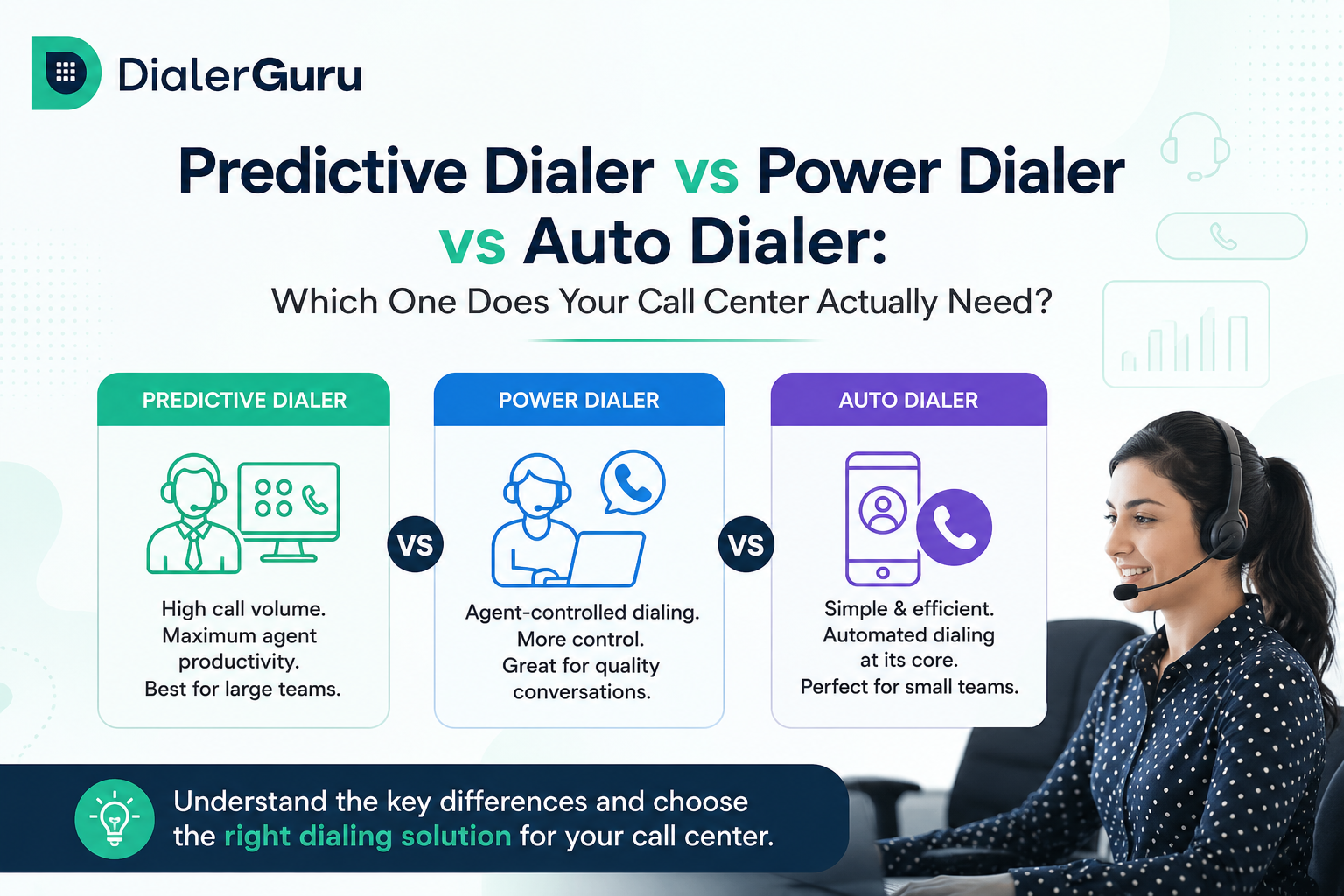
Predictive Dialer vs Power Dialer vs Auto Dialer: Which One Does Your Call Center Actually Need?

Choosing the wrong dialer can quietly kill your call center’s productivity — and in 2026, it can expose you to regulatory fines you never saw coming. If you’ve been researching predictive dialer vs power dialer options and feel overwhelmed by conflicting advice, you’re not alone. Most guides either oversimplify or bury you in technical jargon. This one won’t.

Here’s the truth: “auto dialer” is an umbrella term. What lives beneath it — predictive, power, and progressive dialers — are fundamentally different machines that serve very different operations. Choosing the right one is less about brand preference and more about understanding your team size, your call volume, and how much compliance risk you can realistically manage.

Let’s break it down clearly.

What Is an Auto Dialer, Really?

An auto dialer is any software that automatically dials phone numbers from a list without requiring an agent to punch in each number manually. That’s where the similarity ends. The term “auto dialer” covers at least three distinct dialing modes — and the one you choose will determine your agent productivity, your customer experience, and your legal exposure.

Think of it this way: a pickup truck, an SUV, and a sports car are all “vehicles.” But you wouldn’t take a sports car off-road. Same logic applies here.

Power Dialer: Quality Over Quantity

A power dialer dials one number at a time, per agent. The moment the previous call ends — whether it connected or not — the system automatically places the next call. The agent is live on the line from the first ring, meaning no delayed connection, no awkward silence, and no “telemarketer pause” when the prospect picks up.

How it works:

  • System dials the next contact the instant an agent becomes available
  • Agent sees full CRM data while the phone rings
  • If voicemail answers, the agent drops a pre-recorded message and moves on
  • Zero abandoned calls — every answered call connects to a live person

Best for:

  • B2B sales teams
  • Account-based outreach with high-value prospects
  • Teams of fewer than 8 agents
  • Industries where first impressions are everything (real estate, insurance, healthcare)

Compliance profile: Very low risk. Because every call has a live agent ready before connection, power dialers are TCPA-compliant by design. No abandoned call issues.

The trade-off: Speed. A skilled agent on a power dialer can make 80–120 calls per day — impressive, but lower ceiling than predictive dialers in pure volume terms.

Predictive Dialer: Maximum Volume, Maximum Caution Required

A predictive dialer uses an algorithm to dial multiple numbers simultaneously per agent pool. It predicts using real-time data like average call duration, answer rates, and agent availability when an agent will finish their current call. By the time the next prospect picks up, an agent should theoretically be free.

In a well-tuned operation, this can boost agent talk time by 200–300% compared to manual dialing.

How it works:

  • Algorithm dials 3–5+ numbers per agent simultaneously
  • Answered machine calls are automatically filtered and dropped
  • Live connections are routed to the first available agent
  • Unanswered numbers, busy signals, and disconnected lines are discarded

Best for:

  • Large call centers with 50+ agents
  • High-volume consumer campaigns (telemarketing, debt collection, political outreach)
  • Short-call-duration campaigns like surveys or reminders
  • Situations where raw contact volume is the primary goal

Compliance profile: Higher risk. The FCC mandates a maximum 3% abandoned call rate per campaign period. Predictive dialers — especially with smaller teams — frequently breach this threshold. Fines under TCPA can reach $1,500 per call. At scale, a single compliance failure can be catastrophic.

The trade-off: You gain volume but sacrifice personalization. Prospects often hear a brief delay or silence before an agent connects a signal that immediately says “automated call” and can cost you the conversation before it starts.

Progressive Dialer: The Middle Ground

A progressive dialer sits between power and predictive. It dials a preset number of lines per agent (typically 2–3) rather than dynamically predicting across the whole team. An answering machine detection (AMD) algorithm filters out voicemails and connects agents only to live answers.

It’s faster than a pure power dialer, more controlled than a predictive dialer, and carries minimal abandoned call risk when configured properly.

Best for: Mid-sized teams (10–50 agents) that want speed without the compliance headache of full predictive dialing.

Predictive Dialer vs Power Dialer: The Side-by-Side

FeaturePower DialerPredictive DialerProgressive Dialer
Calls per agent/day80–150200–400+120–200
Abandoned call riskNoneUp to 3% (legal limit)Very low
TCPA compliance riskVery lowHighLow
First impression qualityExcellentFair (delay exists)Good
CRM prep timeYes (during ring)MinimalSome
Minimum team sizeAny50+ agents8+ agents
Best use caseB2B sales, relationship callsHigh-volume consumer outreachMid-market outbound

The 2026 Compliance Landscape Has Changed Everything

This isn’t 2018 anymore. The regulatory environment around outbound dialing has tightened significantly. As of April 2025, consumers can revoke consent by any reasonable means a text reply, an email, even telling a live agent. Businesses have 10 business days to honor those opt-outs.

This single rule change has made list hygiene and DNC scrubbing non-negotiable for any dialer type but especially for predictive dialers running fast-moving campaigns. If your dialer is cycling through 500 numbers an hour and your DNC list hasn’t been scrubbed today, you’re already exposed.

→ Dialer Guru’s DNC Scrubber automates this in real time, so your campaigns stay clean regardless of which dialer mode you’re running.

So, Which Dialer Do You Actually Need?

Here’s the honest decision framework:

Choose a Power Dialer if:

  • Your team has fewer than 15 agents
  • You’re calling B2B decision-makers or high-value leads
  • Call quality, personalization, and conversion rate matter more than sheer volume
  • You’re in a regulated industry (healthcare, insurance, financial services)

Choose a Predictive Dialer if:

  • You run a large call center (50+ agents)
  • You’re doing high-volume consumer campaigns with short call durations
  • You have a dedicated compliance team actively monitoring abandoned call rates
  • Your lists are pre-scrubbed and regularly cleaned

Choose a Progressive Dialer if:

  • You’re a growing team (10–50 agents) that wants to scale volume without full predictive risk
  • You want automation with tighter control than pure predictive mode allows

The Dialer Is Only Half the Battle

Even the best dialer underperforms if your caller ID gets flagged as spam. In 2026, carriers are increasingly aggressive about tagging numbers that generate high-volume, short-duration, or abandoned calls. Once your number is labeled “Scam Likely,” your answer rates collapse — and no dialer mode fixes that.

This is why caller ID reputation management, STIR/SHAKEN compliance, and DNC list hygiene aren’t optional add-ons. They’re the infrastructure that makes your dialer investment worthwhile.

→ See how Dialer Guru’s Hosted Auto Dialer combines all three modes — power, progressive, and predictive — with built-in compliance tools so you’re never choosing between speed and safety.

Final Word

The debate of predictive dialer vs power dialer isn’t about which is “better” — it’s about which is right for your operation. A predictive dialer in the hands of a 5-agent team is a compliance disaster waiting to happen. A power dialer running a 200-agent consumer campaign is leaving money on the table.

Know your team size. Know your campaign type. Know your compliance exposure. Then choose accordingly — and make sure the platform you choose was built with all three in mind.


Dialer Guru offers hosted auto dialer solutions with configurable power, progressive, and predictive dialing modes — built for compliance from the ground up. Contact our team to find the right configuration for your call center.
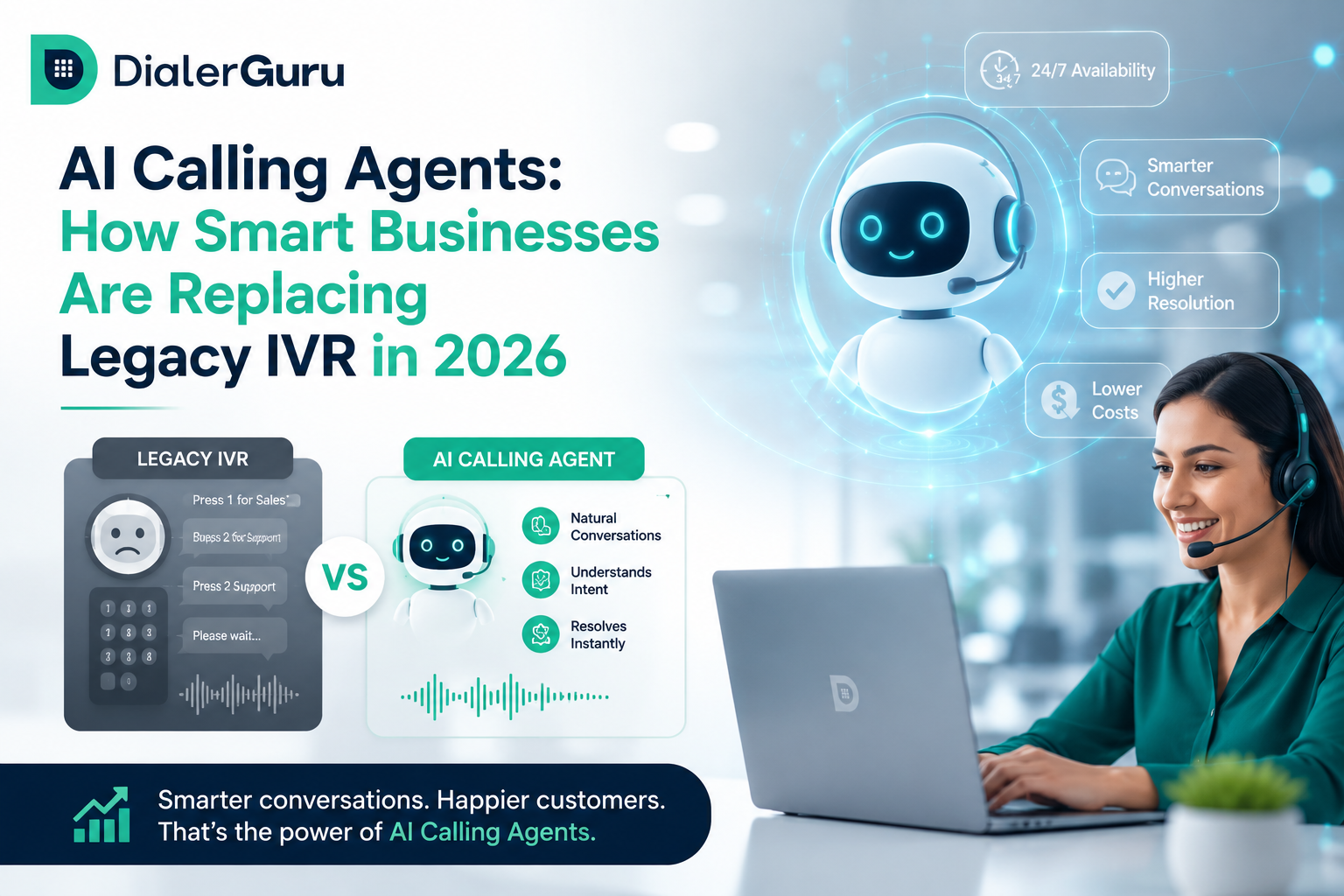
AI Calling Agents: How Smart Businesses Are Replacing Legacy IVR in 2026

The phone rang. An AI answered, confirmed the patient’s appointment, updated the EHR system, and ended the call — in under 90 seconds, at 2:47 AM on a Sunday, without a single human agent involved.

That’s not a pitch for a science fiction product. That’s what AI calling agents for call centers are doing right now in hospitals, real estate brokerages, and insurance agencies across the country. And in 2026, the gap between businesses using them and businesses still relying on legacy IVR is becoming impossible to ignore.

This article explains what AI calling agents actually are, how they work, where they deliver real ROI, and what to look for when evaluating a solution for your operation.

What Is an AI Calling Agent?

An AI calling agent is not a phone tree. This distinction matters enormously.

Legacy IVR (Interactive Voice Response) systems work on rigid menu logic: “Press 1 for billing. Press 2 for support.” They can’t understand natural language, they frustrate callers, and they fail completely when a caller says something unexpected — which is most of the time.

AI calling agents are different. They use large language models (LLMs), speech-to-text (STT), and text-to-speech (TTS) engines to conduct real conversations. They can understand intent, handle variations in how people phrase questions, navigate multi-turn dialogues, pull data from your CRM in real time, and take action — scheduling an appointment, qualifying a lead, answering billing questions, or escalating to a human agent when appropriate.

The result sounds like talking to a competent, patient human assistant. Not a robot menu.

Why 2026 Is the Inflection Point

Three forces have converged to make AI calling agents viable — and in many cases, necessary — right now:

1. Labor costs are unsustainable. Hiring, training, and retaining call center agents is expensive. Turnover in the industry regularly exceeds 30–45% annually. AI agents handle high-volume, repetitive inbound tasks — appointment scheduling, FAQ responses, status updates — without fatigue, turnover costs, or overtime.

2. Consumer expectations have shifted. Callers in 2026 expect immediate answers at any hour. A business that routes after-hours calls to voicemail is quietly sending leads to competitors who answer 24/7.

3. The technology finally works. Eighteen months ago, AI voice agents sounded robotic and handled edge cases poorly. Today, the best platforms operate at sub-400ms latency, support natural interruption-handling, and achieve resolution rates that match — and sometimes exceed — human agents on structured tasks.

Where AI Calling Agents Deliver the Clearest ROI

Healthcare: Scheduling, Reminders & Patient Intake

Healthcare is the single most compelling use case for AI inbound calling agents in 2026. The problem is acute: front desk staff are overwhelmed, phones go unanswered, and no-show rates drain revenue.

AI calling agents handle:

  • Appointment scheduling and rescheduling (including EHR integration with Epic, Athenahealth)
  • Appointment reminders that reduce no-shows
  • Pre-visit intake questions and insurance verification prompts
  • After-hours patient inquiries with intelligent escalation for urgent cases

Clinics using AI call handling report significant reductions in administrative burden, allowing front desk staff to focus on in-office patients rather than phone queues. Patients, meanwhile, can schedule at midnight if they want to — without waiting on hold.

→ See Dialer Guru’s healthcare call center solutions

Real Estate: Lead Response & Tour Scheduling

Speed-to-lead is the difference between a closed deal and a lost one in real estate. Studies consistently show that leads contacted within 5 minutes are dramatically more likely to convert than those reached an hour later. Most agencies can’t staff for that kind of response time — but AI calling agents can.

AI agents in real estate handle:

  • Immediate callback to new listing inquiries — any time of day
  • Qualifying buyer intent and budget before human agents engage
  • Scheduling property tours directly into agent calendars
  • Following up on open house attendees automatically

The result: agents spend their time on ready-to-move buyers rather than cold qualification calls. Pipeline quality improves. Close rates follow.

→ See Dialer Guru’s real estate dialer solutions

Insurance & Lead Generation

Insurance qualification calls are repetitive by nature — the same 8–12 questions asked to hundreds of leads per day. This is exactly what AI calling agents were built for. They qualify inbound leads, gather coverage needs, and route warm prospects to licensed agents who can close.

Combined with an outbound auto dialer for follow-up campaigns, AI inbound agents create a complete call cycle: AI qualifies inbound interest → human agents close → AI handles retention and renewal touchpoints.

What Separates a Good AI Calling Agent from a Bad One

Not all AI calling agent platforms deliver equal results. Here’s what actually matters when evaluating solutions:

Latency and Naturalness

A pause longer than 400–500ms breaks the illusion of a natural conversation. If callers feel like they’re talking to a system, they disengage. Evaluate demo calls critically — does it sound human? Does it handle interruptions gracefully?

CRM and System Integration

An AI agent that can’t write back to your CRM is a dead end. The value is in automation: call logged, contact status updated, follow-up task created — without any human touching it. Confirm what integrations are natively supported versus requiring custom development.

Escalation Intelligence

The best AI calling agents know when to stop. A distressed patient, an angry customer, a prospect who’s ready to close — these calls need human hands. Smart escalation with full context transfer (so the caller doesn’t have to repeat themselves) is non-negotiable.

Compliance and Data Security

In healthcare, HIPAA compliance is mandatory. In financial services, call recording laws apply. Any AI calling agent handling sensitive information must be built with appropriate security certifications, encryption standards, and audit trails.

Industry-Specific Training

A generic AI agent trained on broad conversational data will underperform versus one pre-trained on healthcare workflows, real estate terminology, or insurance qualification scripts. Ask vendors specifically about their vertical training depth.

AI Calling Agents + Auto Dialers: The Complete Outbound-Inbound Stack

Here’s where Dialer Guru’s approach becomes particularly relevant. Most businesses think of AI agents and auto dialers as separate tools. The most effective operations combine them:

  • Outbound: Auto dialer campaigns reach leads at volume, qualify interest, and route live transfers
  • Inbound: AI calling agent answers immediately, handles structured tasks, escalates intelligently
  • Closed loop: CRM updates in both directions create a single source of truth on every contact

The result is a call center that runs at full productivity during business hours, and doesn’t stop working when the office closes.

→ Explore Dialer Guru’s AI Agent product designed for exactly this kind of integrated workflow.

Common Objections — Answered Honestly

“Our customers won’t want to talk to a robot.” Callers don’t want to feel like they’re talking to a robot. A well-built AI calling agent doesn’t feel robotic. The objection is usually about bad IVR experiences being projected onto modern AI — they’re genuinely different technologies.

“We’ll lose the personal touch.” The personal touch is wasted on appointment reminders and FAQ calls. AI handles the transactional volume. Human agents handle the relationship moments. That division of labor actually improves the personal touch where it counts.

“We’re not big enough for AI.” Single-location clinics, boutique real estate agencies, and small insurance teams are already running AI calling agents with strong results. The barrier to entry has dropped significantly — this isn’t enterprise-only technology anymore.

The Bottom Line

AI calling agents for call centers aren’t the future. They’re the present — and in 2026, operating without them in high-call-volume industries is a competitive disadvantage that compounds month over month.

The businesses winning right now are the ones that have figured out exactly where AI handles volume best, where humans add irreplaceable value, and how to build a seamless handoff between the two.


Dialer Guru offers AI inbound calling agents purpose-built for healthcare scheduling, real estate lead response, and insurance qualification — with native integration to our hosted auto dialer platform. Talk to our team today.